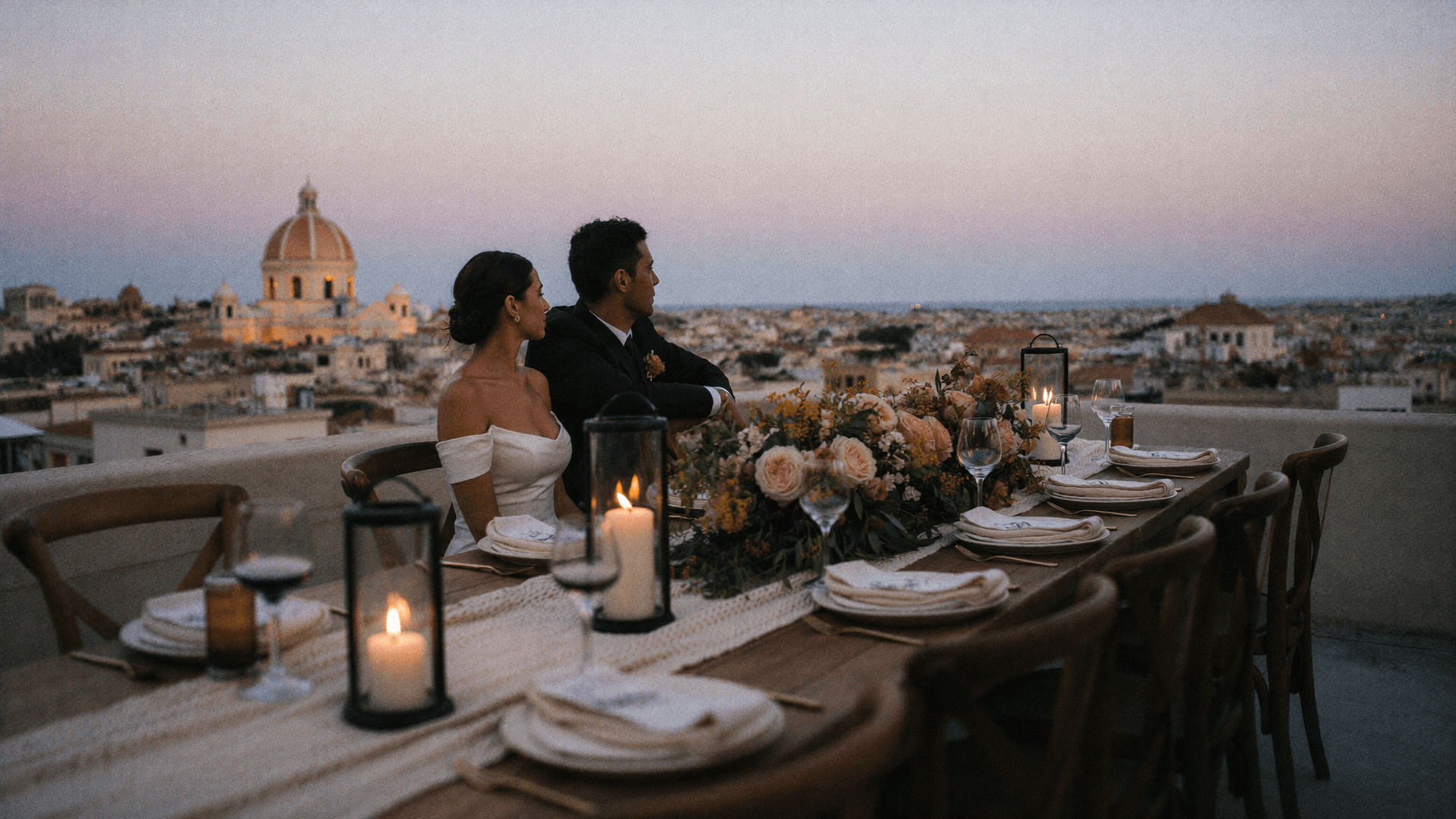
I made the decision to base myself in MedellÃn partway through 2020. Part of that was a practical calculation — Colombia's cost of living relative to Vancouver made the economics of a working photographer's life considerably more sustainable during a period of industry disruption. Part of it was the light. I had visited once before the pandemic and the light in the Valle de Aburrá at golden hour had stayed with me in the specific way that only light you cannot find again tends to stay.
What I did not anticipate was arriving to witness the destination wedding market reshaping itself in real-time around me. Colombia's trajectory as an international destination was already upward before COVID. The pandemic created a step change.
Cartagena Before: The Known Quantity
Cartagena was already Colombia's most established destination wedding location before 2020 — it had the international profile, the boutique hotel infrastructure, the Walled City's visual grandeur that photographs in a register that requires no explanation to an international audience. Pre-pandemic, the Cartagena destination wedding market was predominantly domestic (Colombian families from Bogotá, MedellÃn, Cali planning events on the coast) with a growing international component — mostly North American couples who had heard of Cartagena through travel media.
That international component was expanding, but it was still clearly secondary to the domestic market. Cartagena's Walled City hotel room inventory, while exceptional, was constrained enough that large international events required careful coordination. The pre-pandemic Cartagena wedding I photographed most often was intimate by necessity as much as by choice: the best spaces in the Old City are not large.
Cartagena After: The International Discovery
What the pandemic did to Cartagena is what it did to many locations with strong pre-existing visual identities: it accelerated the process of international discovery. Couples who had spent lockdown scrolling destination wedding content found Cartagena and realized, correctly, that it offered something genuinely unique — a Caribbean destination with the visual richness of a European colonial city rather than the beach-resort aesthetic that dominates the regional market.
The Cartagena market in 2022 and into 2023 is genuinely competitive in a way it was not in 2019. The best Old City venues — the converted colonial palaces, the courtyard hotels — are booking further in advance than they were before. North American and European couples represent a meaningfully larger share of inquiries. Prices have risen across the vendor landscape. This is the pattern of a market that has been discovered and has not yet found its ceiling.
For photographers, this window — when the market is discovered but not yet saturated — is when the most interesting work gets made. The visual vocabulary has not yet become cliché. The best locations are available. I am making Cartagena images in 2022 that I do not think I could make in 2027 if the market continues on its current trajectory.
MedellÃn: The Pandemic's Most Surprising Wedding Destination Story
MedellÃn's emergence as an international destination wedding location during the pandemic period is the story I find most interesting to have watched from the inside. Before COVID, MedellÃn was on most international couples' radar as a city to visit, not as a city to get married in. Its destination wedding market was almost entirely domestic — the Antioquian finca culture, the extended-family estate weddings that have been happening in the hills above the Valle de Aburrá for generations. International couples were a genuine rarity.
What changed is a combination of factors. Colombia's general international profile surged during the pandemic as the country's food culture, coffee culture, and urban transformation story became subjects of sustained international press and social media coverage. MedellÃn specifically — cited repeatedly as a model of urban regeneration — became a destination for a younger, more culturally curious category of international traveller who had not previously been considering South America for a wedding.
The hacienda and finca market around MedellÃn is extraordinary and largely unknown outside Colombia. These are not purpose-built wedding venues — they are working estates that have been hosting family events for a century, with the colonial Antioquian architecture, the mountain backdrop, and the surrounding flower and coffee farms that make the setting genuinely unique. I have photographed six hacienda weddings in Antioquia since relocating, and each one has produced images I consider among my best work. The light in the late afternoon, with the Andes behind everything and the valley floor catching the last hour of sun, is the finest I have found anywhere I have worked.
Bogotá: The Emerging Option
Bogotá remains the most underappreciated destination wedding city in Colombia, and I say that as someone who has spent significant time there and been consistently surprised by what I found. The city's reputation — large, complicated, not obviously romantic — precedes it in a way that obscures what La Candelaria's colonial architecture, Usaquén's tree-lined streets, and the highland surrounding landscape actually look like in photographs.
Post-pandemic, I have seen a small but noticeable increase in Bogotá inquiries from international couples who are approaching Colombia as a destination and want something with a more urban, sophisticated character than Cartagena or MedellÃn provide. The haciendas of the Sabana de Bogotá — the high plateau surrounding the capital — offer a landscape context that is completely different from the tropical valleys of Antioquia: colder, greener, more European in character. Some of the most interesting destination wedding photography I have seen come out of Colombia in the last two years has been from the Bogotá Savannah.
The Direction of Travel
Colombia in 2023 is at the beginning of what I expect to be a sustained period of growth as an international destination wedding market. The factors driving it — the light, the landscape diversity, the cost differential relative to European alternatives, the improving international flight connections — are structural rather than trend-driven. They will not reverse. The market will develop, prices will rise, and the window of discovering Colombia before it becomes the expected answer will narrow. I am watching that window from inside it, and I am making as many images as I can while it remains open.
Destination Wedding Photographer
Vancouver · Medellín · Worldwide


