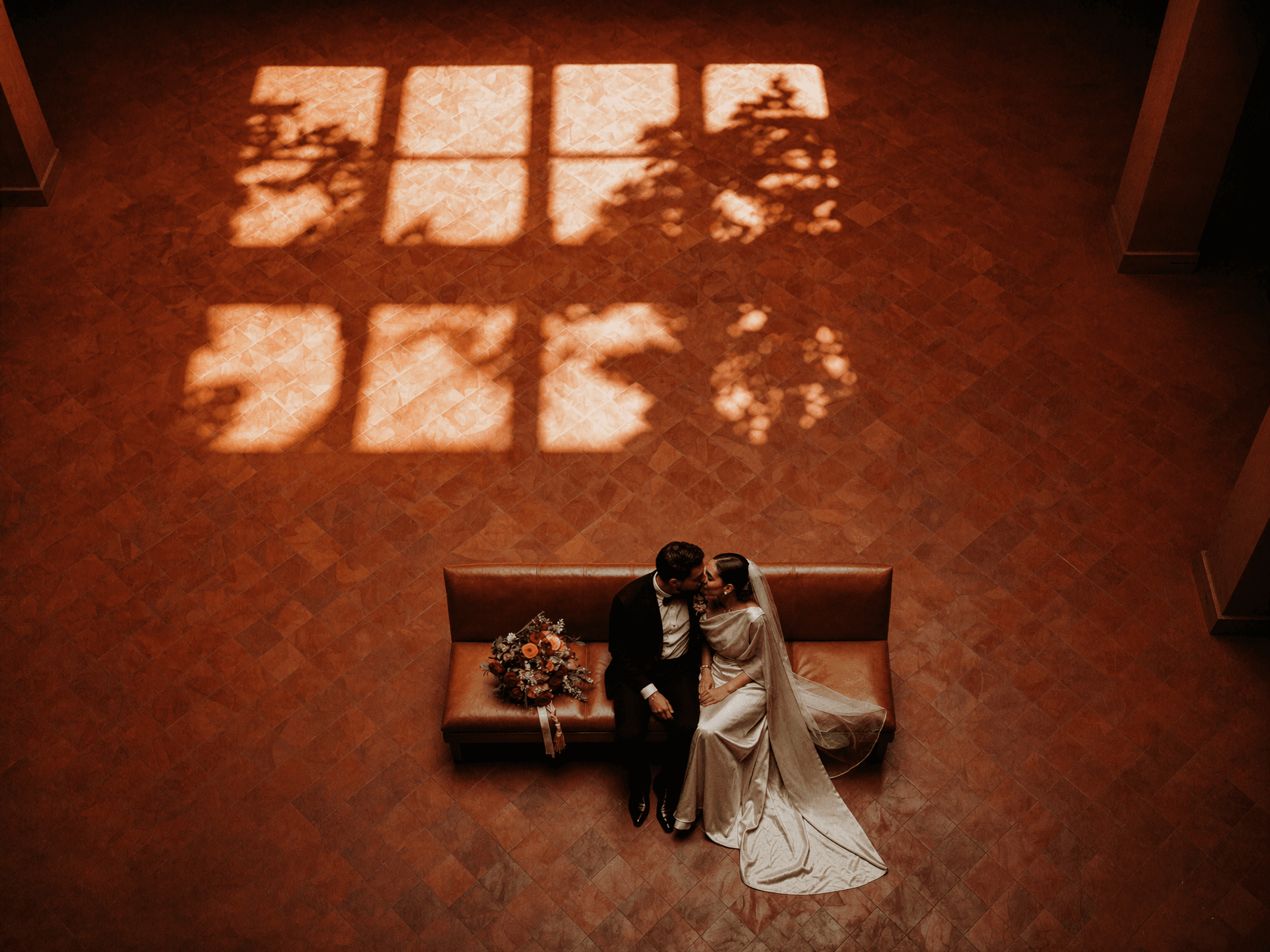
I want to tell you something that might sound counterintuitive coming from a photographer who has built a career on elopements: some of the most extraordinary images I have ever made were at elopements. Not despite the absence of a crowd, but because of it.
The absence of audience changes everything.
What Disappears When the Crowd Does
At a traditional elopement with 80 to 150 guests, the couple is, functionally, performing. Not inauthentically, they genuinely feel what they feel, but the presence of so many witnesses creates an audience-awareness that shapes every expression, every gesture, every moment of emotion. People manage themselves. They hold it together for the room. They laugh at the right moments and cry with appropriate restraint.
None of that is dishonest. But it is modulated. And modulated emotion photographs differently than unmodulated emotion.
At an elopement, the modulation disappears. I have watched couples exhale in a way I have rarely seen at larger elopements, a physical relaxation that happens in the first hour when they realize there is no performance required. The laughter comes differently. The silences are different. The private language they have between themselves, which is usually carefully rationed in public, floods the day.
The Financial Argument
A traditional elopement in Canada or the US runs between $30,000 and $80,000 on average in 2026. The majority of that budget is absorbed by catering, venue hire for a space large enough for the guest list, and the logistical complexity of managing a large event. What remains for the things that actually produce lasting memories, photography, flowers, experience, location, is often a fraction of the total.
An elopement budget of $15,000 to $20,000 funds a destination you actually want to visit, a photographer you actually want to hire, and an experience that belongs entirely to the two of you. The math changes completely when you stop dividing by 120.
What the Photography Can Do
When I photograph an elopement, I am not managing a schedule of family formals, vendor meals, or crowd coverage. I have the full day, sometimes two days, to follow the light, respond to the mood, and find the images that could only be made of these two people in this specific place at this specific hour.
The editorial sessions at elopements are longer and more exploratory. I can take a couple to a location I found while scouting that morning because the light hits the wall in a particular way at 4pm and not at any other time. I can wait for the moment rather than manufacture it. The resulting images have a quality of found beauty, deliberate but not forced, shaped but not staged, that I find very difficult to achieve at larger events.
The Courage of the Choice
Couples who choose to elope are, in my experience, making a decision that requires genuine clarity about what they actually want rather than what they feel they are supposed to want. That clarity, the knowledge that this day is specifically about the two of them and no one else, shows in every frame.
The most honest images I make are at elopements. That is not a coincidence. It is the direct result of a couple who decided the elopement was for them.
What You Are Actually Deciding Between
The comparison between your destination and your destination as elopement destinations is a comparison between two different versions of what a ceremony can feel like, and the photographs that each version produces. Both locations have genuine merit. The question is which version of the experience is the one that matches what you actually want, not which location is objectively better. your destination gives you one specific combination of setting, atmosphere, access, and visual character. your destination gives you a different combination. Understanding what is specific to each, rather than which one scores higher on a general quality scale, is the information that makes the decision meaningful rather than arbitrary.
The practical factors that tend to be genuinely different between your destination and your destination: access logistics, permit requirements, the type of accommodation available, the proximity to vendors who know the location well, and the travel time from major departure cities. The photographic factors that tend to be different: the quality and direction of the light at the ceremony site, the background that the location provides, the degree of privacy available during peak season, and the visual vocabulary already established by prior photography from each place. Both the practical and the photographic factors are worth researching specifically for each location rather than assuming that the one that appears more in popular travel media is the more useful choice for an elopement.

Who Each Location Is Best Suited For
The couples who choose your destination and are most satisfied with the decision tend to share certain priorities: a specific aesthetic that your destination delivers and your destination does not, a willingness to manage the logistics that your destination’s access requires, and a relationship to the place that makes its particular character meaningful rather than interchangeable. The couples who choose your destination and are most satisfied tend to prioritise the different version of each of these things: a different aesthetic, a different logistics tolerance, and a different relationship to what makes the place significant. Neither is a better decision in the abstract. Both are the right decision for the specific couple who makes it.
The couples who are most likely to feel uncertain about the choice after the fact are the ones who chose based on external pressure, recommendations from people who do not know their specific priorities, or the assumption that the more photographed location is automatically the better choice for their ceremony. The strongest elopement photographs at any destination come from couples who are genuinely present in the space and connected to why they chose it. That presence shows in the photographs regardless of which location was chosen, and its absence shows just as clearly. The location decision that produces the best photographs is the one made with full information about what each place actually is and a clear sense of which one is right for the specific couple.
Making the Most of the your destination Context
Every destination has a specific context that is worth using deliberately rather than treating as background. At your destination, that context is the combination of light quality, natural or architectural setting, and the particular atmosphere of the place at different times of day. The sessions that use this context most effectively are the ones where the couple has spent time at your destination before the ceremony day: walking the neighbourhood, sitting at a viewpoint, becoming familiar with the place at different hours so that on the ceremony morning it is somewhere they know rather than somewhere they are experiencing for the first time under the pressure of the session schedule.
I recommend arriving at your destination at least one full day before the ceremony date for this reason. The first day is for orientation: finding the route to the ceremony site, having a meal at a restaurant they want to return to that evening, walking through the area without a camera or a schedule. The second day is the ceremony day, and the familiarity accumulated on the first day shows in how the couple moves through the space and how present they are during the session rather than navigating it as strangers. The photographs from a couple who knows the place, even slightly, are different from the photographs of a couple experiencing it for the first time.
Making the Most of the your destination Context
Every destination has a specific context that is worth using deliberately rather than treating as background. At your destination, that context is the combination of light quality, natural or architectural setting, and the particular atmosphere of the place at different times of day. The sessions that use this context most effectively are the ones where the couple has spent time at your destination before the ceremony day: walking the neighbourhood, sitting at a viewpoint, becoming familiar with the place at different hours so that on the ceremony morning it is somewhere they know rather than somewhere they are experiencing for the first time under the pressure of the session schedule.
I recommend arriving at your destination at least one full day before the ceremony date for this reason. The first day is for orientation: finding the route to the ceremony site, having a meal at a restaurant they want to return to that evening, walking through the area without a camera or a schedule. The second day is the ceremony day, and the familiarity accumulated on the first day shows in how the couple moves through the space and how present they are during the session rather than navigating it as strangers. The photographs from a couple who knows the place, even slightly, are different from the photographs of a couple experiencing it for the first time.
Destination Wedding Photographer
Vancouver · Medellín · Worldwide


