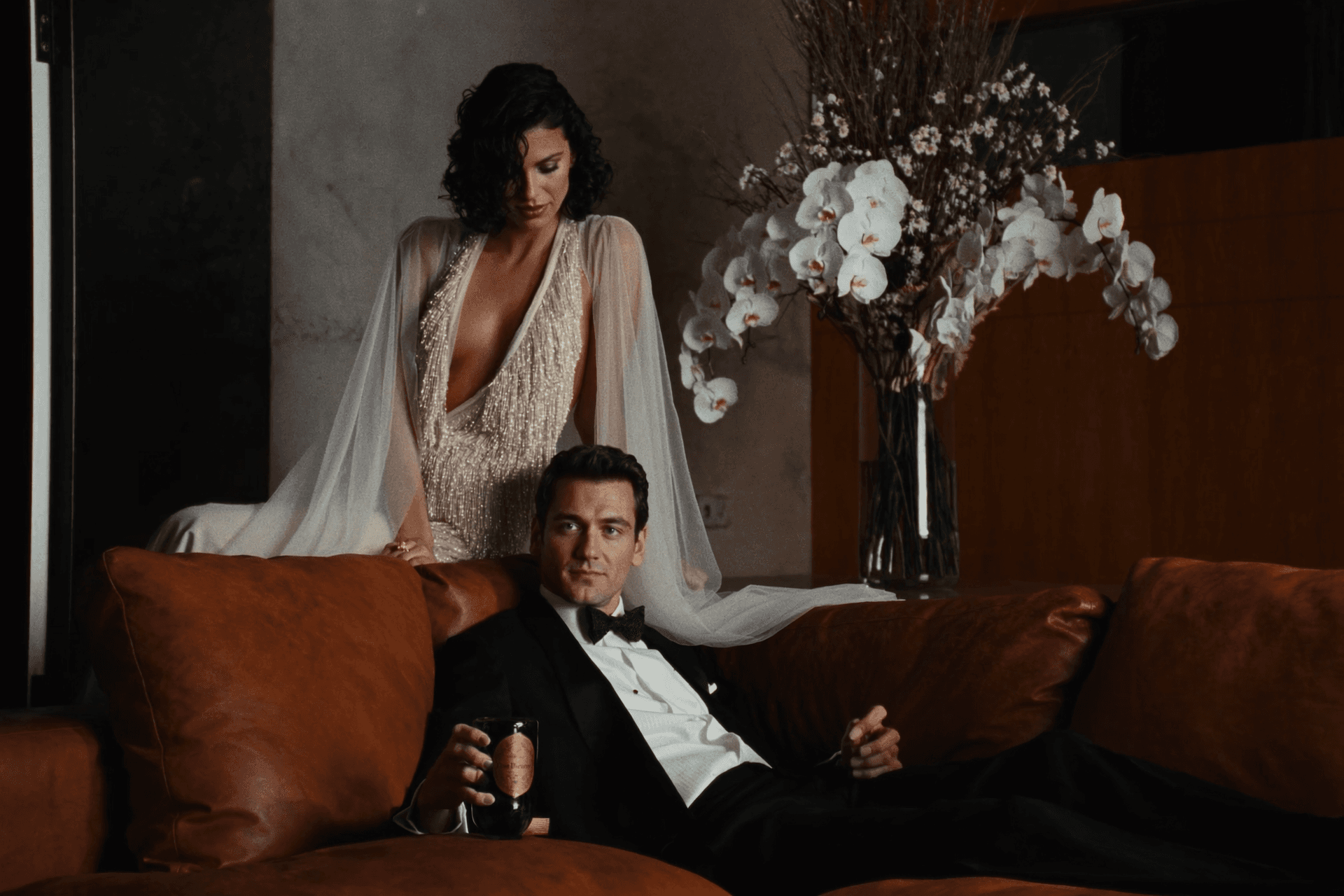
Elopement photography trends in 2026 have shifted in a clear direction: away from the over-edited, heavily posed, preset-driven aesthetic that defined the early 2020s, and toward something that feels more honest, more cinematic, and more personal. I am seeing this in inquiry after inquiry. Couples know what they do not want before they know what they do.
Here is what is actually landing right now.
Documentary Coverage: Story Over Staging
The biggest shift I have seen is couples prioritising coverage over posing. They want their day photographed like a film, not a catalogue shoot. That means more time dedicated to natural moments, the chaos of getting ready, the emotion between people who love each other, and less time in formal portrait setups. Documentary coverage has always existed, but in 2026 it is the dominant request. Couples are specifically asking photographers: "How much of the day do you spend directing vs. observing?"
True-to-Life Color: The Preset Backlash
The over-warm, desaturated, faded-highlight look that dominated Instagram through the early 2020s is clearly losing ground. Couples are requesting accurate skin tones, clean whites, and colors that actually match what they saw and wore. They are pulling up galleries and asking: "Does this look like the real thing?" The answer they want is yes.
Motion and Energy: Blur as Intention
Used well, motion blur communicates something that sharp images cannot: the energy of a first dance, the spin of a dress, the chaos of a celebratory moment where everyone is moving. Couples in 2026 are increasingly open to, and specifically requesting, images that let that movement show rather than freeze it to nothing. The key word is "intentional." Bad blur is just a missed shot. Good blur is a choice.
Editorial-Inspired Imagery: Fashion Meets Elopement Day
On the other end of the spectrum, editorial elopement photography is having a genuine moment. Think Vogue-style portraiture: graphic compositions, precise framing, strong use of architectural context. Couples who see their elopement as an aesthetic event, not just a party, are asking for this approach. The best photographers are offering it as a distinct portrait session style layered on top of documentary coverage of the day.
Film and Analogue Aesthetics
Whether shot on actual film or processed to emulate it, the analogue look is not going away. In 2026 it has moved from niche request to mainstream option. The warmth, grain, and tonal character of film simply ages better than the clean digital look, and couples are increasingly aware of this when making their choice.
What ties all of these trends together is the same thing: couples want photographs that feel like theirs. Not like a trend. Not like someone else's elopement filtered through a preset pack. Something specific to them, their people, and the particular light of their particular day.
That has always been the goal. 2026 couples are just getting better at articulating it.
Why This Matters More Than Most Couples Realise
The question of the biggest elopement photography trends sits at an intersection that the elopement industry does not always make visible: the gap between what an elopement or elopement is supposed to look like and what it actually feels like to the people in it. The photographs produced in that gap, between the performed version and the genuine version of the same day, are consistently the ones couples return to most often in the years after the event. The images that show what was actually true about the morning rather than what was staged for the camera are the ones that hold meaning over time, because they contain real information about who the couple was on that specific day rather than a record of how well they executed a visual template.
The specific relevance of the biggest elopement photography trends to elopement and elopement photography is that it forces a choice between two approaches that cannot be fully reconciled: the approach that optimises for how things look in the moment and the approach that optimises for what the photographs will mean over time. These approaches are not always in conflict, but when they are, the couples who have thought about the difference in advance make better decisions than the couples who discover the conflict on the day. Thinking about the biggest elopement photography trends before you plan your session is not overthinking. It is the kind of preparation that allows the session itself to be genuinely spontaneous rather than spontaneous-looking.

How I Apply This in the Sessions I Photograph
The practical implications of the biggest elopement photography trends for how I work are specific: I spend less time directing couples into positions and more time watching what happens when they are not being directed. I build the session structure around the moments that occur naturally at each location, the walk between ceremony and portrait location, the quiet before the ceremony begins, the unrehearsed interaction between the couple during the fifteen minutes after the ceremony ends, rather than filling every moment with scripted activity. The most consistent predictor of a strong elopement gallery is not the quality of the locations or the light, though both matter. It is the degree to which the couple is genuinely present rather than performing presence.
The sessions that produce the work I am most proud of are the ones where the couple has thought about why they are there, what the ceremony means to them specifically, and what they want the photographs to show about who they were on that day. These are the sessions where I am not the most important person in the room. The couple is the most important person in the room, and my job is to be invisible enough that what they are doing is fully visible. the biggest elopement photography trends understood in advance is what creates the conditions for that kind of photography rather than making it a matter of luck when it occasionally happens.
Making the Most of the your destination Context
Every destination has a specific context that is worth using deliberately rather than treating as background. At your destination, that context is the combination of light quality, natural or architectural setting, and the particular atmosphere of the place at different times of day. The sessions that use this context most effectively are the ones where the couple has spent time at your destination before the ceremony day: walking the neighbourhood, sitting at a viewpoint, becoming familiar with the place at different hours so that on the ceremony morning it is somewhere they know rather than somewhere they are experiencing for the first time under the pressure of the session schedule.
I recommend arriving at your destination at least one full day before the ceremony date for this reason. The first day is for orientation: finding the route to the ceremony site, having a meal at a restaurant they want to return to that evening, walking through the area without a camera or a schedule. The second day is the ceremony day, and the familiarity accumulated on the first day shows in how the couple moves through the space and how present they are during the session rather than navigating it as strangers. The photographs from a couple who knows the place, even slightly, are different from the photographs of a couple experiencing it for the first time.
Making the Most of the your destination Context
Every destination has a specific context that is worth using deliberately rather than treating as background. At your destination, that context is the combination of light quality, natural or architectural setting, and the particular atmosphere of the place at different times of day. The sessions that use this context most effectively are the ones where the couple has spent time at your destination before the ceremony day: walking the neighbourhood, sitting at a viewpoint, becoming familiar with the place at different hours so that on the ceremony morning it is somewhere they know rather than somewhere they are experiencing for the first time under the pressure of the session schedule.
I recommend arriving at your destination at least one full day before the ceremony date for this reason. The first day is for orientation: finding the route to the ceremony site, having a meal at a restaurant they want to return to that evening, walking through the area without a camera or a schedule. The second day is the ceremony day, and the familiarity accumulated on the first day shows in how the couple moves through the space and how present they are during the session rather than navigating it as strangers. The photographs from a couple who knows the place, even slightly, are different from the photographs of a couple experiencing it for the first time.
Destination Wedding Photographer
Vancouver · Medellín · Worldwide


