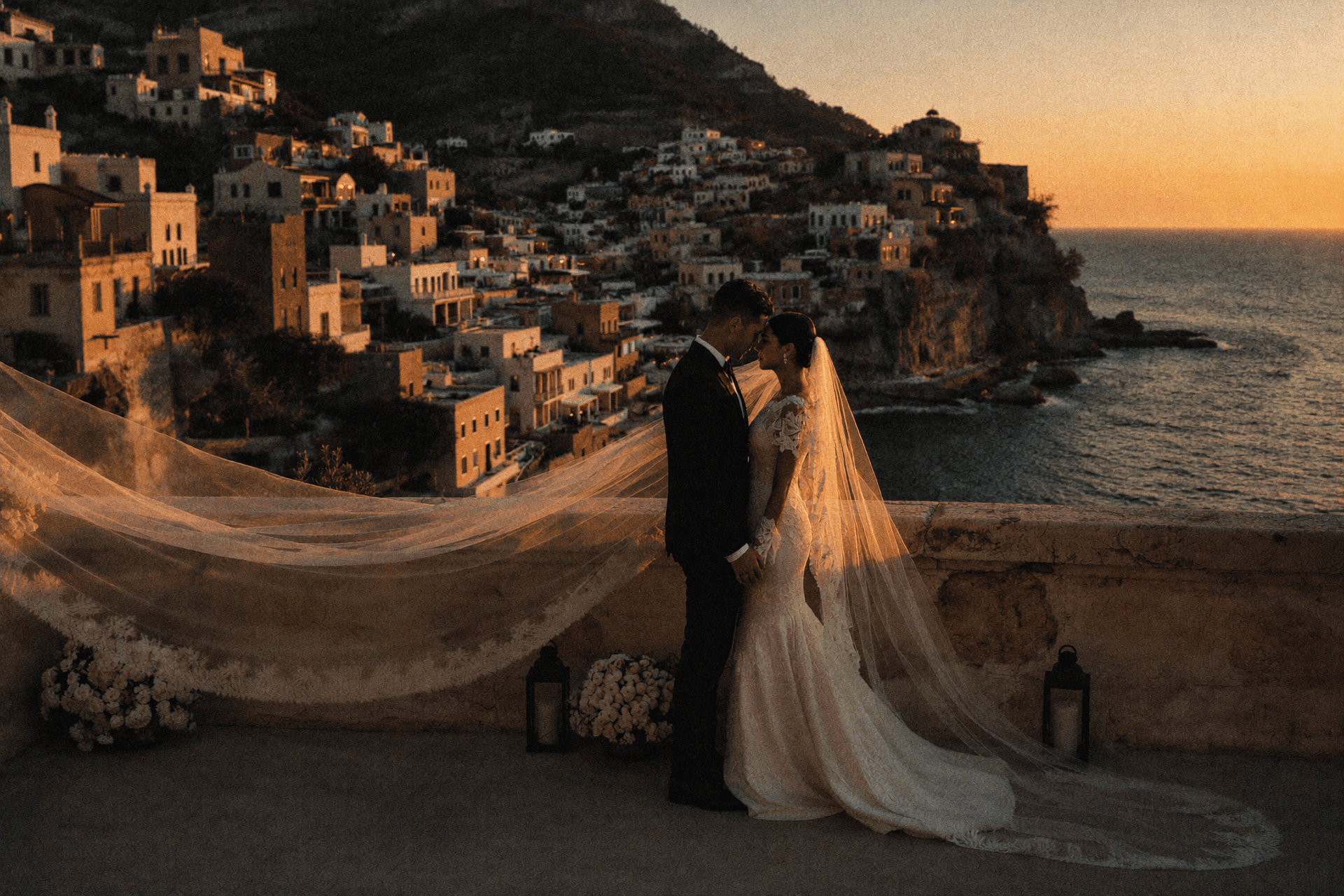
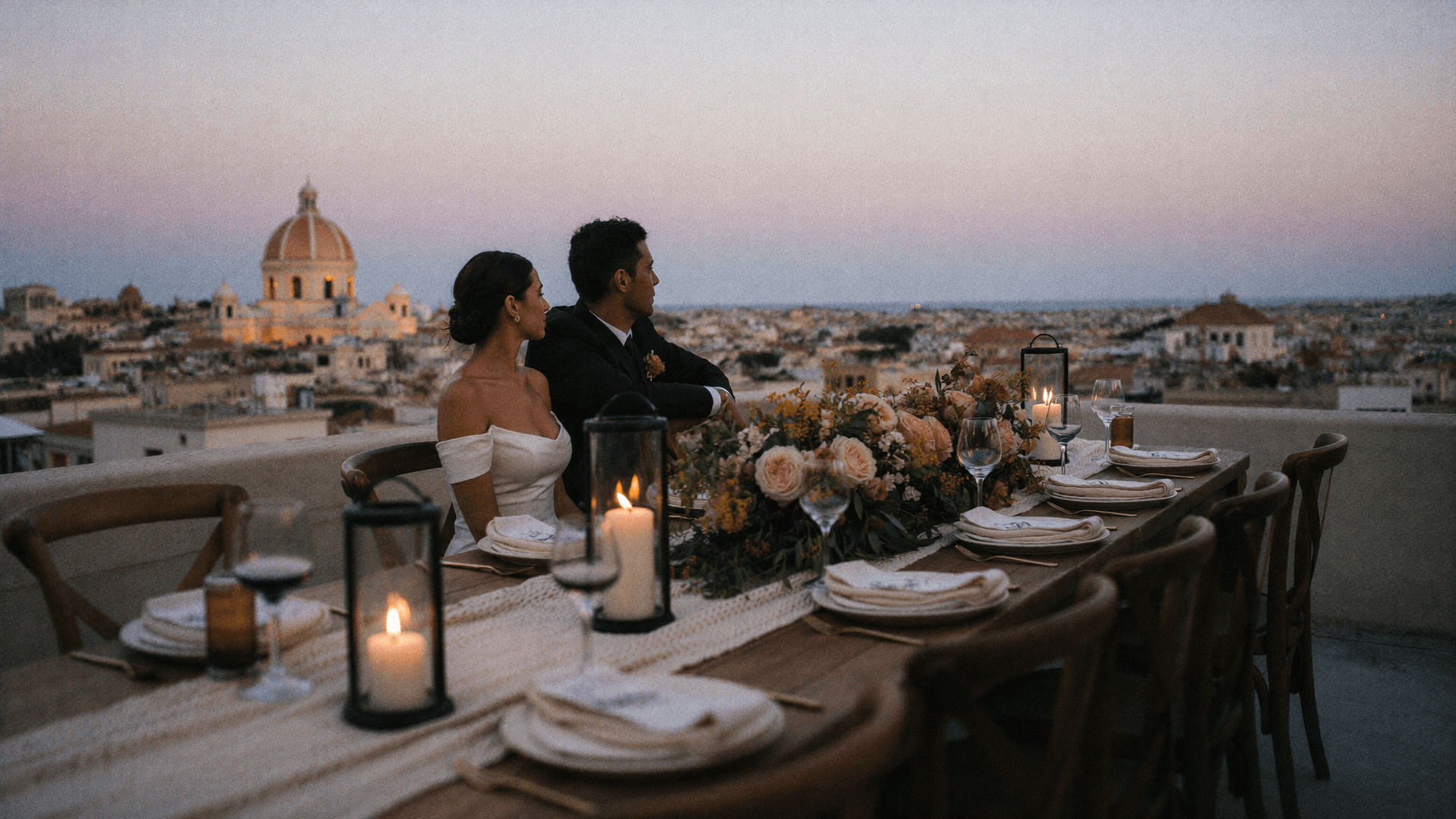
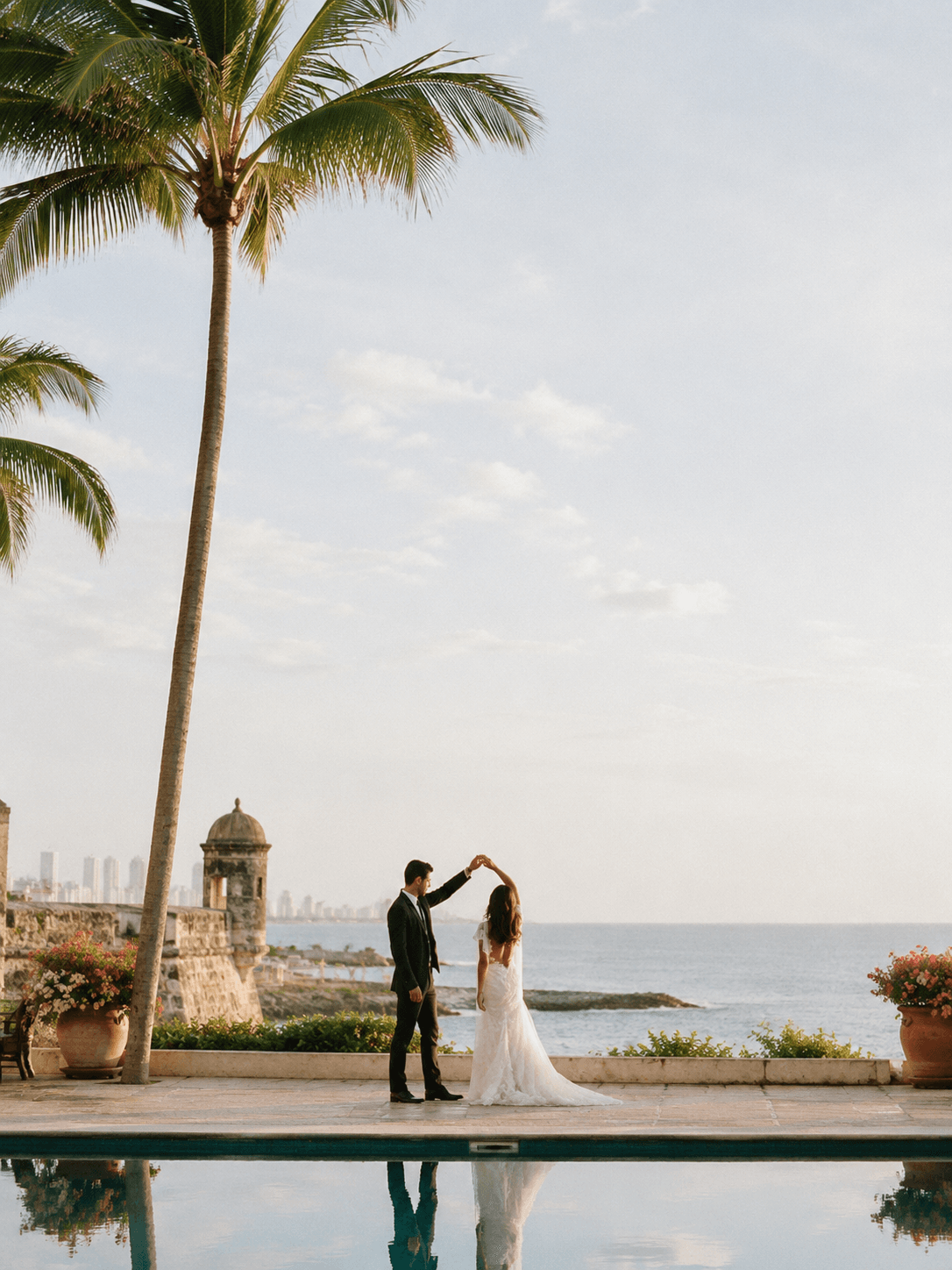
There is a counterintuitive truth about destination elopements that most photographers know but rarely say out loud: being somewhere unfamiliar makes people more present. And presence is everything in elopement photography.
When you elope in the city where you grew up, surrounded by the venues you have driven past a hundred times, in a format your parents' friends will recognize immediately, your nervous system has a familiar framework to lean on. This is not a criticism. It is simply how the human brain works. Familiarity creates comfort, and comfort creates a certain kind of relaxation, but it does not always create aliveness.
Destination elopements are different. When you are in Cartagena and the light is doing something you have never seen before and the music is coming from somewhere you cannot identify and the air smells completely unlike home, something happens to the people in my photographs. Their eyes are different. They are actually seeing each other, often in a way they haven't in years of comfortable daily life.
The Light Argument
Every destination has its own quality of light, and that quality is often radically different from what you find in the climates where most North American and European couples live. The light in MedellÃn at 5pm on a clear day is some of the most beautiful natural light I have ever worked in: soft, directional, warm without being harsh, and produced by the particular angle of the equatorial sun at altitude. The light in Tuscany in October feels like it has been filtered through centuries. The light in Cartagena at golden hour bounces off old stone and creates a warmth that no studio could replicate.
In destination cities, this extraordinary light is the default. Not the exception you hope for. The reliable, predictable baseline you build your shooting day around.
The Architecture Argument
When the setting is exceptional, the photographs are automatically elevated. A portrait taken in front of an 800-year-old archway draped in bougainvillea requires less compositional intervention than one taken in front of a ballroom wall. This is not to say that good photography is about beautiful backgrounds. It is not. But when the environment is working with you rather than against you, there is more visual oxygen available for the moments that matter: the glance, the held hand, the involuntary smile.
The Guest Argument
Destination elopements tend to attract only the people who genuinely want to be there. The guest list self-selects for love. You are not obligated to invite the entire extended family or everyone from the office. The people who travel to Cartagena or Tuscany or Dubai for your elopement have made a choice. They are present in a way that obligated guests sometimes are not. This changes the energy in every room I photograph. It changes the quality of the toasts. It changes the way people hold each other on the dance floor.
The Intimacy Argument
Destination elopements are almost always smaller. Not always, but often. And smaller means I can find you in the crowd. It means the quiet moments between the scheduled ones are not hidden somewhere in a room of 300 people. It means the first dance is not something that happens thirty meters away from where I am standing. Intimacy of scale produces intimacy of image.
The Photographer Argument
When I travel to photograph a destination elopement, I am also being somewhere unfamiliar. My eyes are fresh. I am not on autopilot. I am not defaulting to the angle I used at this venue last September. I am looking, genuinely looking, at a place I may never have photographed before. This active attention shows up in the images.
The best elopement photographs I have ever taken were not taken in a studio or at a familiar venue. They were taken in places where something unexpected was always possible, where the light was doing something I had to pay attention to catch, and where the people in front of my lens were fully, completely, unavoidably present in their own lives.
Get married somewhere that asks something of you. The photographs will reflect it.
Why This Matters More Than Most Couples Realise
The question of why destination elopements produce better photography sits at an intersection that the elopement industry does not always make visible: the gap between what an elopement or elopement is supposed to look like and what it actually feels like to the people in it. The photographs produced in that gap, between the performed version and the genuine version of the same day, are consistently the ones couples return to most often in the years after the event. The images that show what was actually true about the morning rather than what was staged for the camera are the ones that hold meaning over time, because they contain real information about who the couple was on that specific day rather than a record of how well they executed a visual template.
The specific relevance of why destination elopements produce better photography to elopement and elopement photography is that it forces a choice between two approaches that cannot be fully reconciled: the approach that optimises for how things look in the moment and the approach that optimises for what the photographs will mean over time. These approaches are not always in conflict, but when they are, the couples who have thought about the difference in advance make better decisions than the couples who discover the conflict on the day. Thinking about why destination elopements produce better photography before you plan your session is not overthinking. It is the kind of preparation that allows the session itself to be genuinely spontaneous rather than spontaneous-looking.

How I Apply This in the Sessions I Photograph
The practical implications of why destination elopements produce better photography for how I work are specific: I spend less time directing couples into positions and more time watching what happens when they are not being directed. I build the session structure around the moments that occur naturally at each location, the walk between ceremony and portrait location, the quiet before the ceremony begins, the unrehearsed interaction between the couple during the fifteen minutes after the ceremony ends, rather than filling every moment with scripted activity. The most consistent predictor of a strong elopement gallery is not the quality of the locations or the light, though both matter. It is the degree to which the couple is genuinely present rather than performing presence.
The sessions that produce the work I am most proud of are the ones where the couple has thought about why they are there, what the ceremony means to them specifically, and what they want the photographs to show about who they were on that day. These are the sessions where I am not the most important person in the room. The couple is the most important person in the room, and my job is to be invisible enough that what they are doing is fully visible. why destination elopements produce better photography understood in advance is what creates the conditions for that kind of photography rather than making it a matter of luck when it occasionally happens.

Making the Most of the your destination Context
Every destination has a specific context that is worth using deliberately rather than treating as background. At your destination, that context is the combination of light quality, natural or architectural setting, and the particular atmosphere of the place at different times of day. The sessions that use this context most effectively are the ones where the couple has spent time at your destination before the ceremony day: walking the neighbourhood, sitting at a viewpoint, becoming familiar with the place at different hours so that on the ceremony morning it is somewhere they know rather than somewhere they are experiencing for the first time under the pressure of the session schedule.
I recommend arriving at your destination at least one full day before the ceremony date for this reason. The first day is for orientation: finding the route to the ceremony site, having a meal at a restaurant they want to return to that evening, walking through the area without a camera or a schedule. The second day is the ceremony day, and the familiarity accumulated on the first day shows in how the couple moves through the space and how present they are during the session rather than navigating it as strangers. The photographs from a couple who knows the place, even slightly, are different from the photographs of a couple experiencing it for the first time.
Destination Wedding Photographer
Vancouver · Medellín · Worldwide