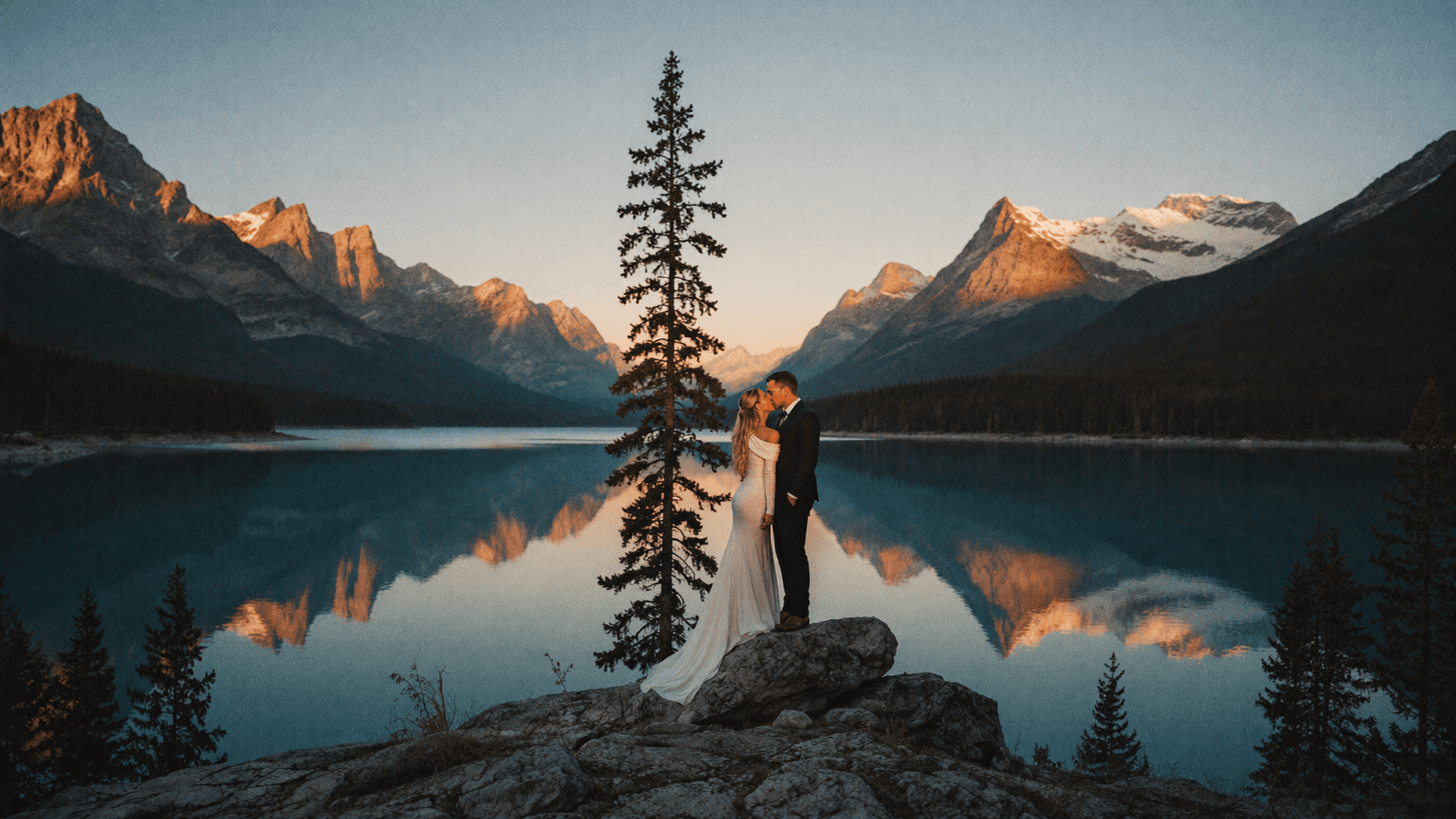
Jasper National Park is designated as the largest dark sky preserve in the world. The designation is not marketing: it is an International Dark Sky Association certification based on sky quality measurements that confirm the absence of light pollution at a scale that encompasses the entire 11,000-square-kilometre park. On a clear night in Jasper in September, the Milky Way is visible as a physical structure rather than a faint suggestion, bright enough that it produces visible shadows on the ground when the moon is below the horizon. A ceremony under this sky is a ceremony under conditions that most people who grew up in or near cities have never experienced. The reaction when the couple first steps outside and looks up is consistently the same regardless of how much photography they have seen: they stop moving and they look for a long time.
The Dark Sky Preserve and What It Means
The Jasper Dark Sky Festival happens every October and draws astronomers and visitors from across the country to a week of star parties, telescope viewings, and educational events in the park. But the dark sky is available every clear night, not only during the festival. The park prohibits the installation of outdoor lighting that would contribute to light pollution and requires that existing lighting meets specific shielding standards. The result is that driving out of Jasper townsite by ten kilometres in any direction and turning the headlights off puts you in genuine darkness: the kind that requires time for the eyes to adjust before the full sky becomes apparent.
The best dark sky sites for a ceremony are in the Athabasca Valley between Jasper and the Columbia Icefield, where the flat terrain allows the Milky Way arc to extend from horizon to horizon without terrain obstruction. The pull-outs along the Icefields Parkway north of Sunwapta Pass are accessible by vehicle and give a broad flat foreground with the mountain silhouettes visible against the galaxy above. The ceremony setup here is minimal: the couple, the officiant, and me with a camera on a tripod. The sky provides everything else.

Photography in the Jasper Night
Night photography in Jasper operates on the same principles as at Uyuni or the Atacama but with the specific alpine character of the Canadian Rockies: the mountain silhouettes against the Milky Way are the compositional anchors, the pine forest foreground gives a more complex texture than the flat salt or desert floor of the South American dark sky sites, and the cold is more reliable. September through March in Jasper means temperatures well below freezing at night. The ceremony clothing needs to accommodate extended outdoor time in genuine cold. I use the same off-camera flash technique as at Uyuni to illuminate the couple during long exposures without washing out the sky above.
The specific advantage of Jasper over the other dark sky sites I photograph in is accessibility. The sites near Uyuni require altitude acclimatisation, flights to Bolivia, and significant logistical preparation. The Atacama requires flights to Chile and a specific dry season window. Jasper is a four-hour drive from Edmonton or a five-hour drive from Calgary, the park is open year-round, and the dark sky quality is among the best in the world. For North American couples who want a genuine dark sky ceremony without the international logistics, Jasper is the answer.
Best Times
The Milky Way is most prominent in the Jasper sky from late March through October, with September and October giving the best combination of galactic core visibility, consistently cold and clear nights, and the autumn colour in the foreground that the summer months do not have. The festival in October brings more visitors to the park but the ceremony sites away from the townsite are not affected by festival attendance. November through February gives excellent dark sky conditions but the Milky Way core is below the horizon: the winter sky offers different constellations and the aurora borealis replaces the galaxy as the primary celestial feature, which is a different but equally extraordinary ceremony backdrop.
Destination Wedding Photographer
Vancouver · Medellín · Worldwide