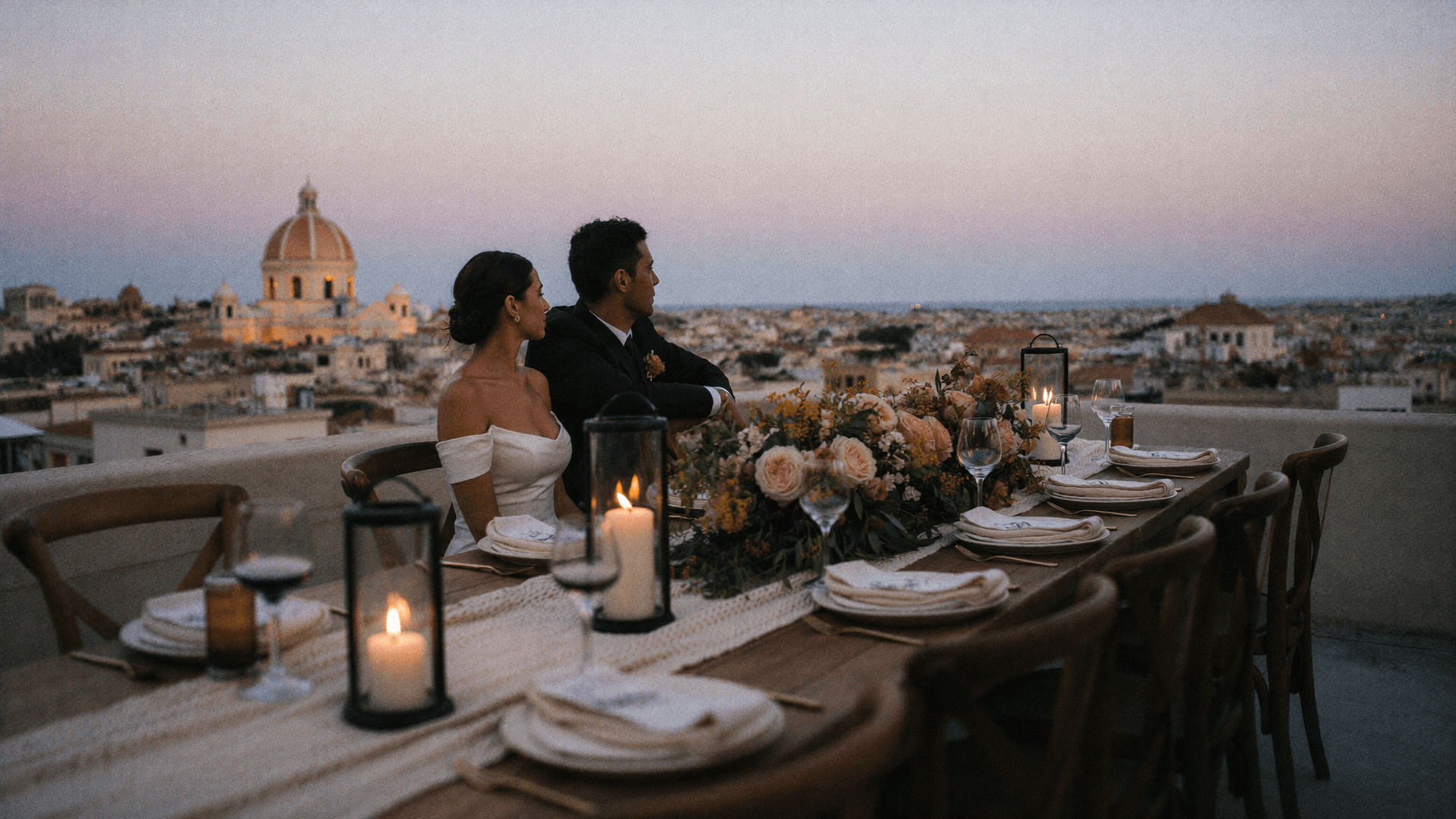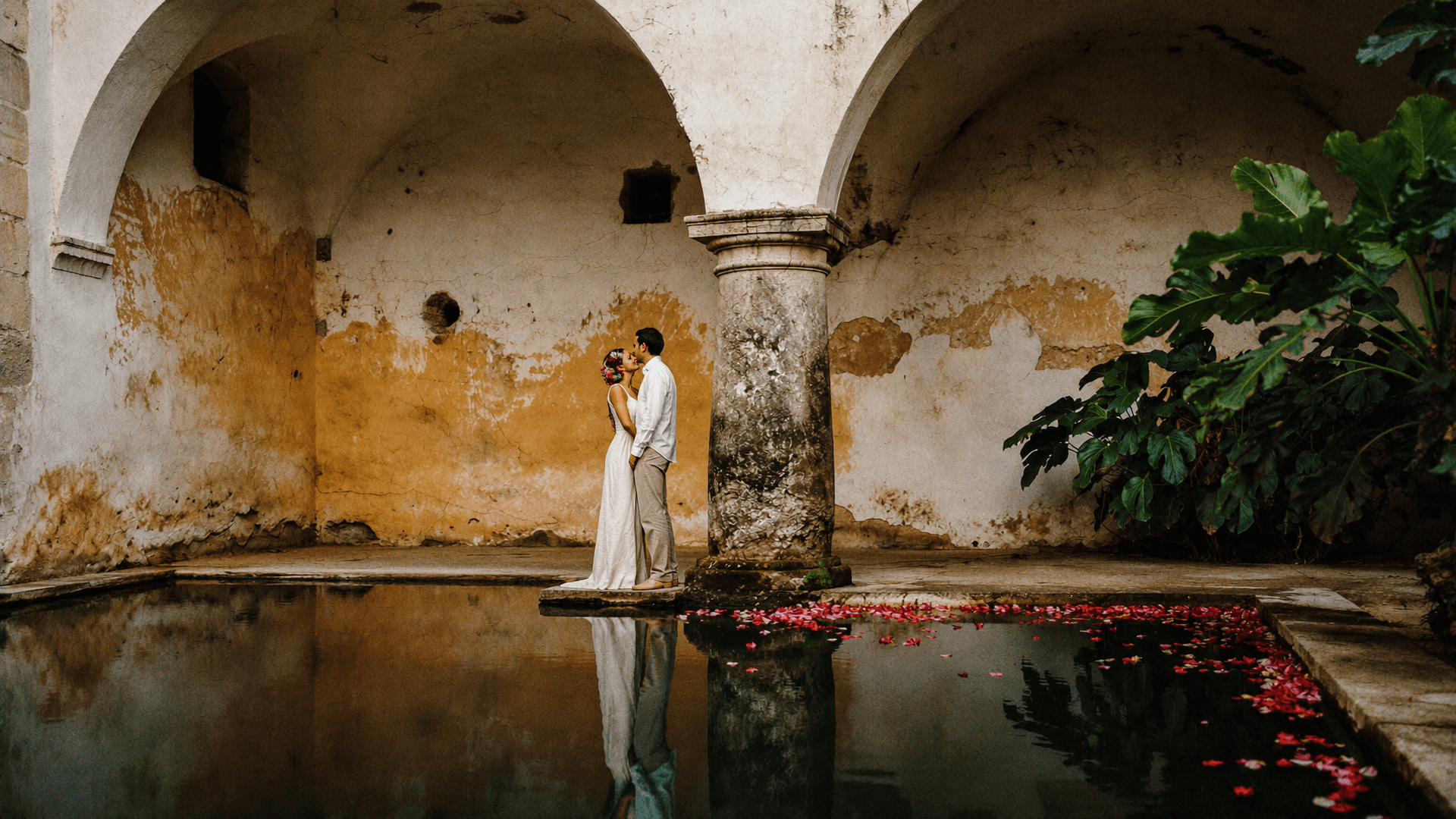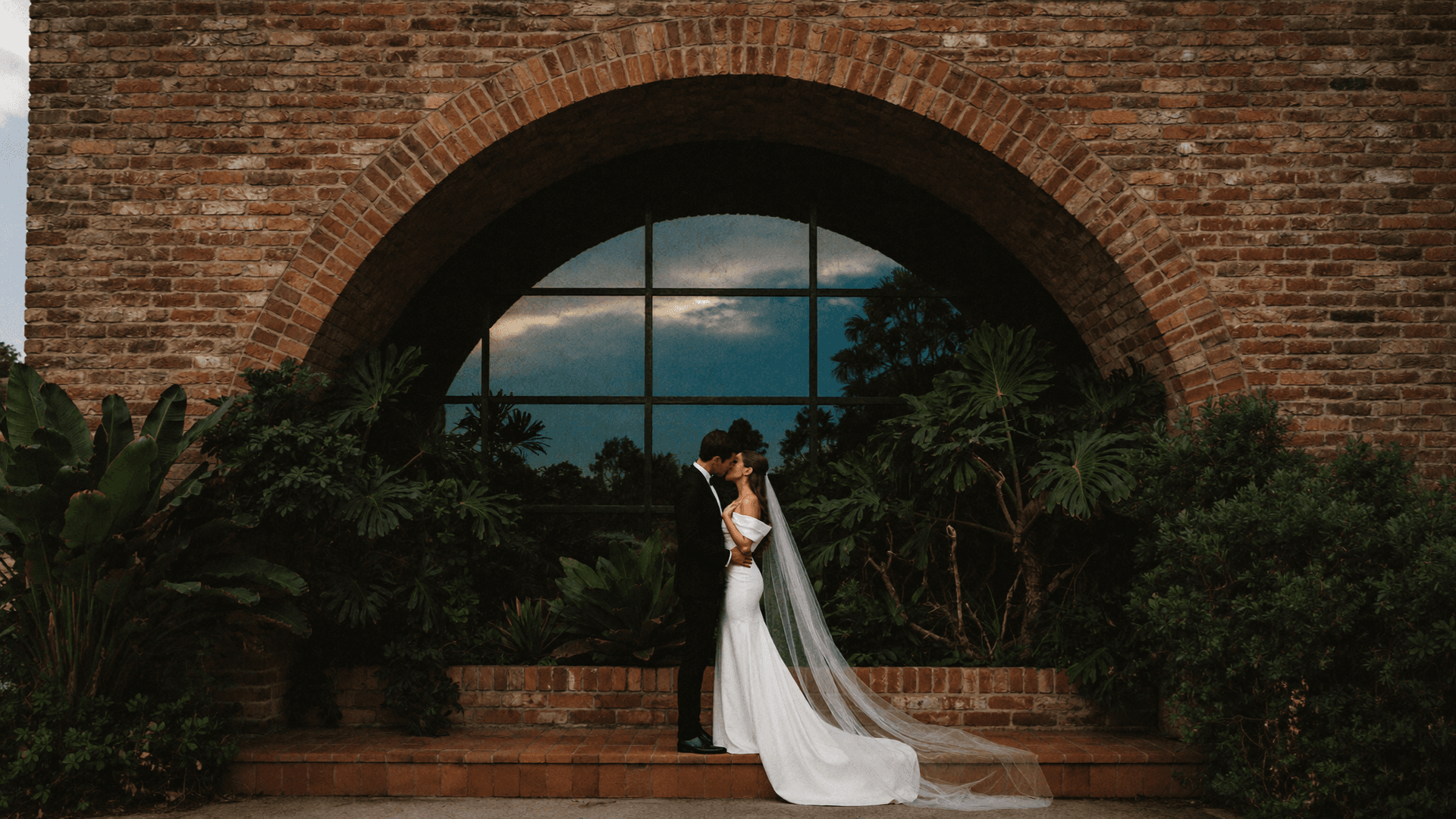
Europe will always have prestige. Italy, France, Greece, Spain, Portugal: the heritage, the architecture, the wine, the history. These are real things that produce real images. I have shot elopements there and I will go back. But in 2026, the calculation for couples who want something genuinely distinctive is changing, and I want to make an honest case for what South America offers that Europe increasingly cannot.

The Visual Saturation Problem with Europe
Lake Como boat photos. Tuscan villa table settings. Amalfi cliff portraits. Paris bridge sessions. Santorini white walls. These images are beautiful. They are also among the most reproduced images in destination elopement photography. When every photographer who shoots in these locations produces similar frames, the visual vocabulary becomes predictable. And predictable is the enemy of memorable.
I say this not to criticize the photographers or the locations. Both are exceptional. But couples who want a gallery that feels specifically theirs, that could not have been made anywhere else, are increasingly aware that the most famous European venues carry this risk. You are not hiring a photographer to document a location. You are hiring a photographer to document the two of you in a location. The location should be working for you, not against you.

What South America Offers That Europe Does Not
Texture. This is the honest photographic answer. Cartagena's colonial walls in morning light have a warmth and patina that nothing in Europe replicates. The hacienda outside Medellin where the elopement happens is not on anyone's Instagram highlights list. The Cartagena courtyard your planner found is not on the first page of Google Images. That freshness shows in the photographs in a way that no amount of skilled editing can manufacture after the fact.
South America also gives you privacy that overtouristed European destinations struggle to provide. The Atacama Desert at dawn is not sharing that moment with three other elopement parties. The Colombian Pacific coast, accessible only by small plane, gives the couple the entire beach. Buenos Aires combines European architectural scale with a Latin energy and nighttime atmosphere that produces images with a character I have not found anywhere in fifteen years of destination work.

The Scale Difference
The Amazon basin is the largest tropical forest on the planet. The Atacama is the driest non-polar desert on Earth. The Andes run the full length of a continent. Patagonia at the southern tip is as close to the end of the world as you can reach with a commercial flight. These are not comparably scaled environments to anything in Europe, and the photographs reflect that difference. When the landscape has that kind of scale behind the couple, the images carry a weight that is genuinely difficult to achieve anywhere else.

The Practical Case
For North American couples, the flight time to Colombia is comparable to or shorter than many European destinations. The cost differential is significant: what your elopement budget achieves in Medellin or Cartagena is substantially more than the equivalent in Italy or France. The food and wine culture of Argentina, Chile, and Uruguay is world-class and paired with accommodation and venue costs that are a fraction of Tuscany equivalents. And while Europe has been a destination for generations of travelers, South America still has the quality that no amount of money can buy back once it is gone: it feels like somewhere you actually discovered.

What You Are Actually Deciding Between
The comparison between your destination and your destination as elopement destinations is a comparison between two different versions of what a ceremony can feel like, and the photographs that each version produces. Both locations have genuine merit. The question is which version of the experience is the one that matches what you actually want, not which location is objectively better. your destination gives you one specific combination of setting, atmosphere, access, and visual character. your destination gives you a different combination. Understanding what is specific to each, rather than which one scores higher on a general quality scale, is the information that makes the decision meaningful rather than arbitrary.
The practical factors that tend to be genuinely different between your destination and your destination: access logistics, permit requirements, the type of accommodation available, the proximity to vendors who know the location well, and the travel time from major departure cities. The photographic factors that tend to be different: the quality and direction of the light at the ceremony site, the background that the location provides, the degree of privacy available during peak season, and the visual vocabulary already established by prior photography from each place. Both the practical and the photographic factors are worth researching specifically for each location rather than assuming that the one that appears more in popular travel media is the more useful choice for an elopement.

Who Each Location Is Best Suited For
The couples who choose your destination and are most satisfied with the decision tend to share certain priorities: a specific aesthetic that your destination delivers and your destination does not, a willingness to manage the logistics that your destination’s access requires, and a relationship to the place that makes its particular character meaningful rather than interchangeable. The couples who choose your destination and are most satisfied tend to prioritise the different version of each of these things: a different aesthetic, a different logistics tolerance, and a different relationship to what makes the place significant. Neither is a better decision in the abstract. Both are the right decision for the specific couple who makes it.
The couples who are most likely to feel uncertain about the choice after the fact are the ones who chose based on external pressure, recommendations from people who do not know their specific priorities, or the assumption that the more photographed location is automatically the better choice for their ceremony. The strongest elopement photographs at any destination come from couples who are genuinely present in the space and connected to why they chose it. That presence shows in the photographs regardless of which location was chosen, and its absence shows just as clearly. The location decision that produces the best photographs is the one made with full information about what each place actually is and a clear sense of which one is right for the specific couple.
Making the Most of the your destination Context
Every destination has a specific context that is worth using deliberately rather than treating as background. At your destination, that context is the combination of light quality, natural or architectural setting, and the particular atmosphere of the place at different times of day. The sessions that use this context most effectively are the ones where the couple has spent time at your destination before the ceremony day: walking the neighbourhood, sitting at a viewpoint, becoming familiar with the place at different hours so that on the ceremony morning it is somewhere they know rather than somewhere they are experiencing for the first time under the pressure of the session schedule.
I recommend arriving at your destination at least one full day before the ceremony date for this reason. The first day is for orientation: finding the route to the ceremony site, having a meal at a restaurant they want to return to that evening, walking through the area without a camera or a schedule. The second day is the ceremony day, and the familiarity accumulated on the first day shows in how the couple moves through the space and how present they are during the session rather than navigating it as strangers. The photographs from a couple who knows the place, even slightly, are different from the photographs of a couple experiencing it for the first time.
Making the Most of the your destination Context
Every destination has a specific context that is worth using deliberately rather than treating as background. At your destination, that context is the combination of light quality, natural or architectural setting, and the particular atmosphere of the place at different times of day. The sessions that use this context most effectively are the ones where the couple has spent time at your destination before the ceremony day: walking the neighbourhood, sitting at a viewpoint, becoming familiar with the place at different hours so that on the ceremony morning it is somewhere they know rather than somewhere they are experiencing for the first time under the pressure of the session schedule.
I recommend arriving at your destination at least one full day before the ceremony date for this reason. The first day is for orientation: finding the route to the ceremony site, having a meal at a restaurant they want to return to that evening, walking through the area without a camera or a schedule. The second day is the ceremony day, and the familiarity accumulated on the first day shows in how the couple moves through the space and how present they are during the session rather than navigating it as strangers. The photographs from a couple who knows the place, even slightly, are different from the photographs of a couple experiencing it for the first time.
Destination Wedding Photographer
Vancouver · Medellín · Worldwide