When to Elope in Torres del Paine
The towers are hidden on most days. You are not booking a view, you are booking enough chances at one.
The towers are behind cloud on the majority of days, and the park is famous for delivering all four seasons before lunch. Any honest season guide to this place has to start there rather than with a table of average temperatures.
So the question is not which month guarantees the view. No month does. The question is which month gives you the most chances, the most usable light and the fewest closures, and those three answers are not the same month.
Here is each season as I actually work it, including the one I quietly prefer and the one I will build only for the right couple.
(Continued on Page 2, Col. 1)
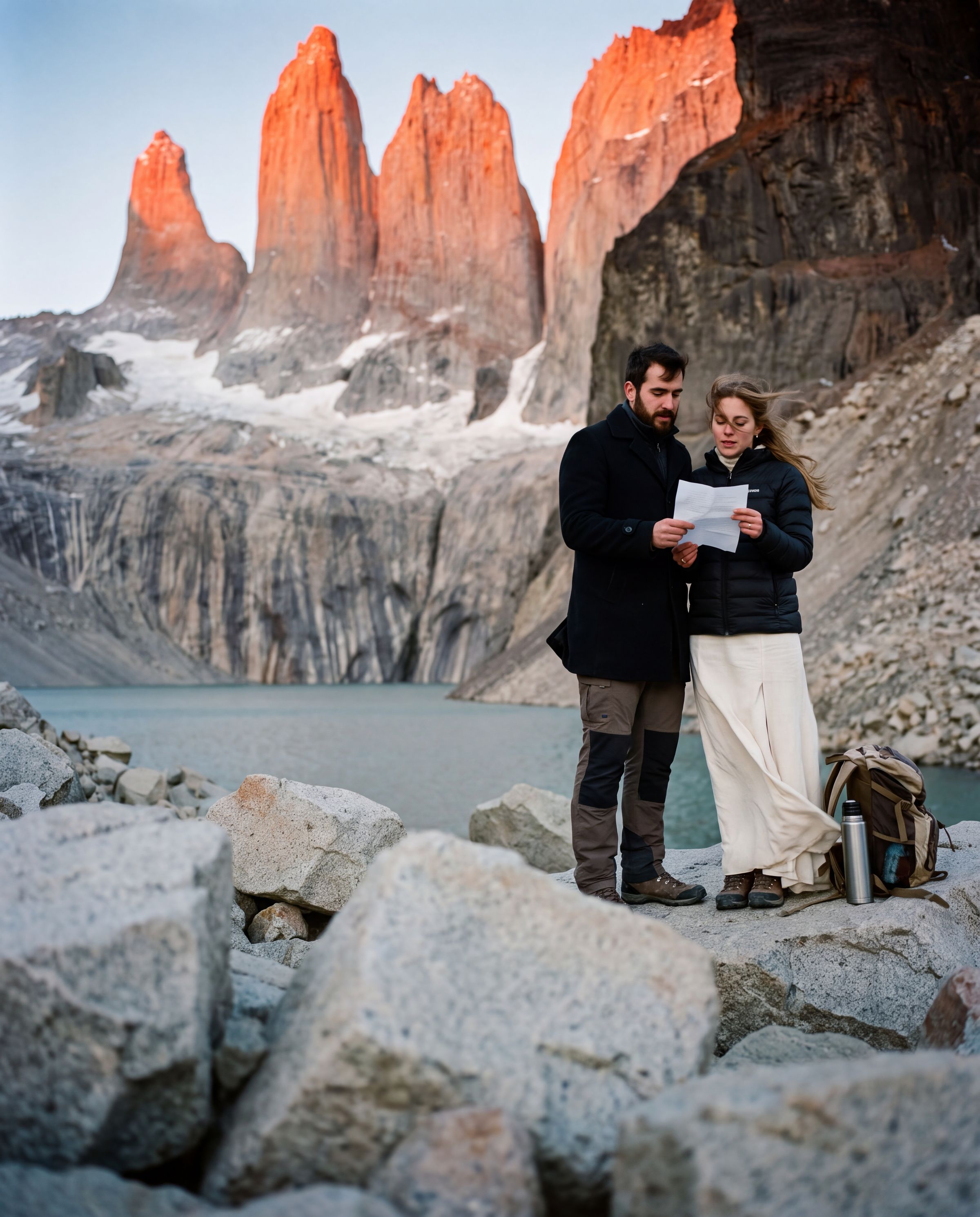
December to February: everything open, everything windy
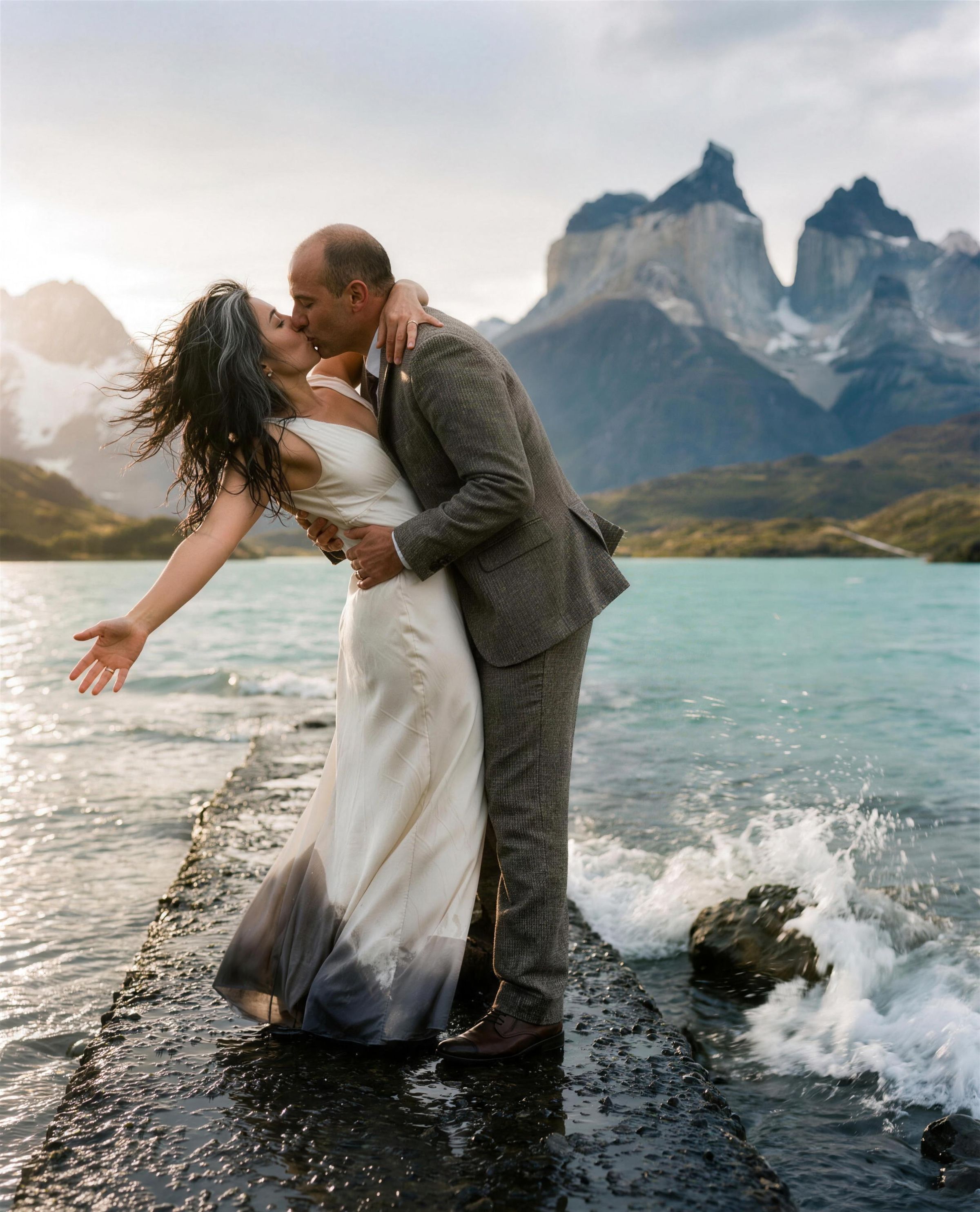
This is the peak and it earns the name. The park is fully open, every sector is reachable, and the daylight runs to sixteen or seventeen hours. The towers can take first light before five in the morning, which gives you an alpenglow window most of the year cannot.
It is also when the wind is at its most serious. Gusts over a hundred kilometres an hour on exposed ground are an unremarkable summer afternoon here, and that is not a warning so much as a description. It will affect what you can wear, where you can stand and what time you stand there.
The other cost is company. This is when everybody else comes too, the refugios and park hotels are full, and the entry reservations for the busiest sectors go early. If you want these weeks, you are working eight to twelve months out, and that is as much about beds as it is about me.
March into April: the shoulder I would put you in
If your dates are flexible at all, this is where I would put you, and I say so knowing it costs me the easier sell. March into April is the shoulder and it is better than the peak on almost every axis that matters to a wedding.
The forests turn red and gold across the lower slopes. The crowds thin sharply after the southern summer holidays end. And the air is noticeably calmer, which in a park defined by wind is not a small thing: it widens where you can hold a ceremony and what you can wear to it.
What you give up is daylight and a little certainty. The days shorten, the first weather systems of autumn arrive, and by late April some higher routes start to become unreliable. The trade is roughly two hours of light for a much better chance of standing still while you say something out loud.
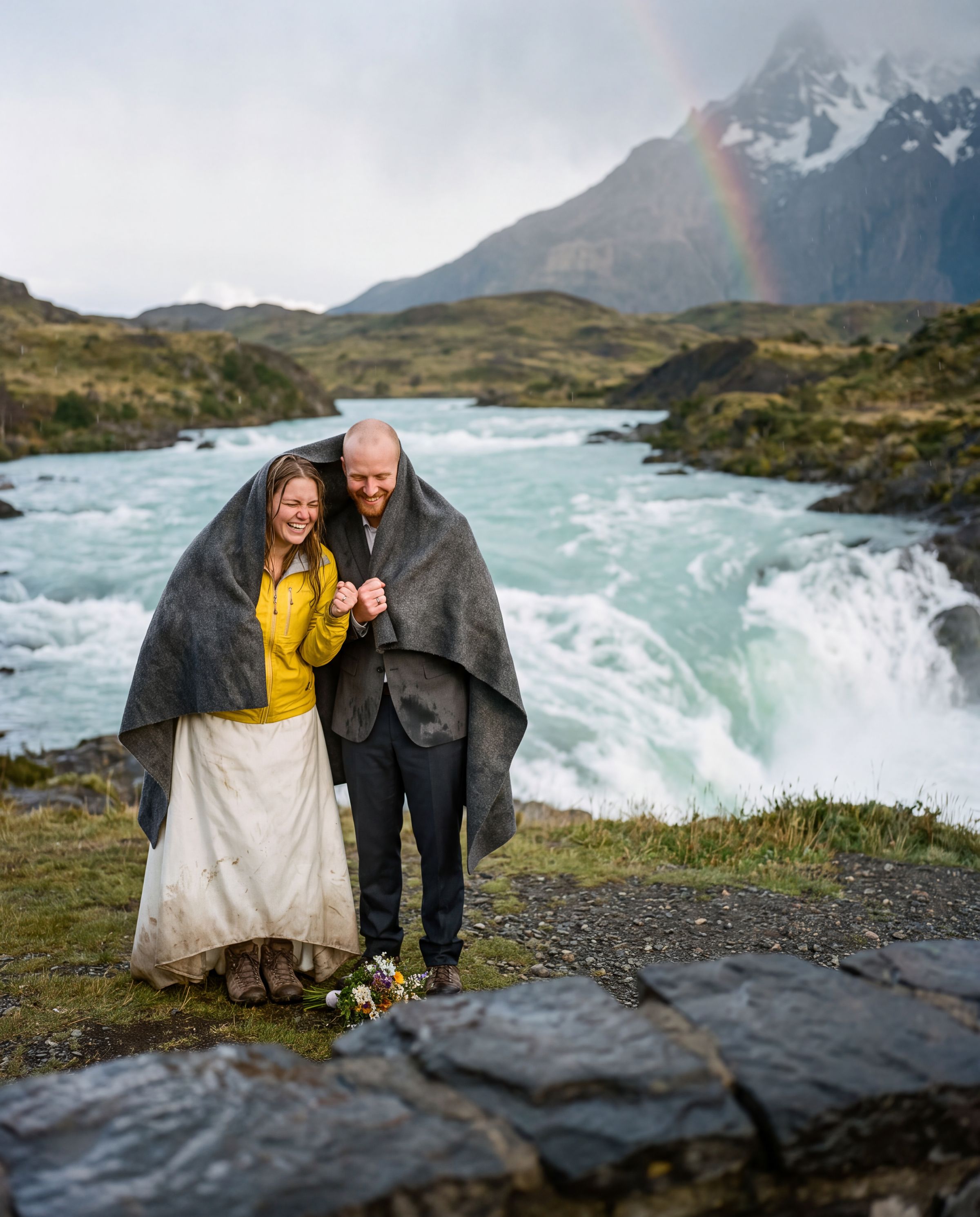
November: the opening, and the gamble
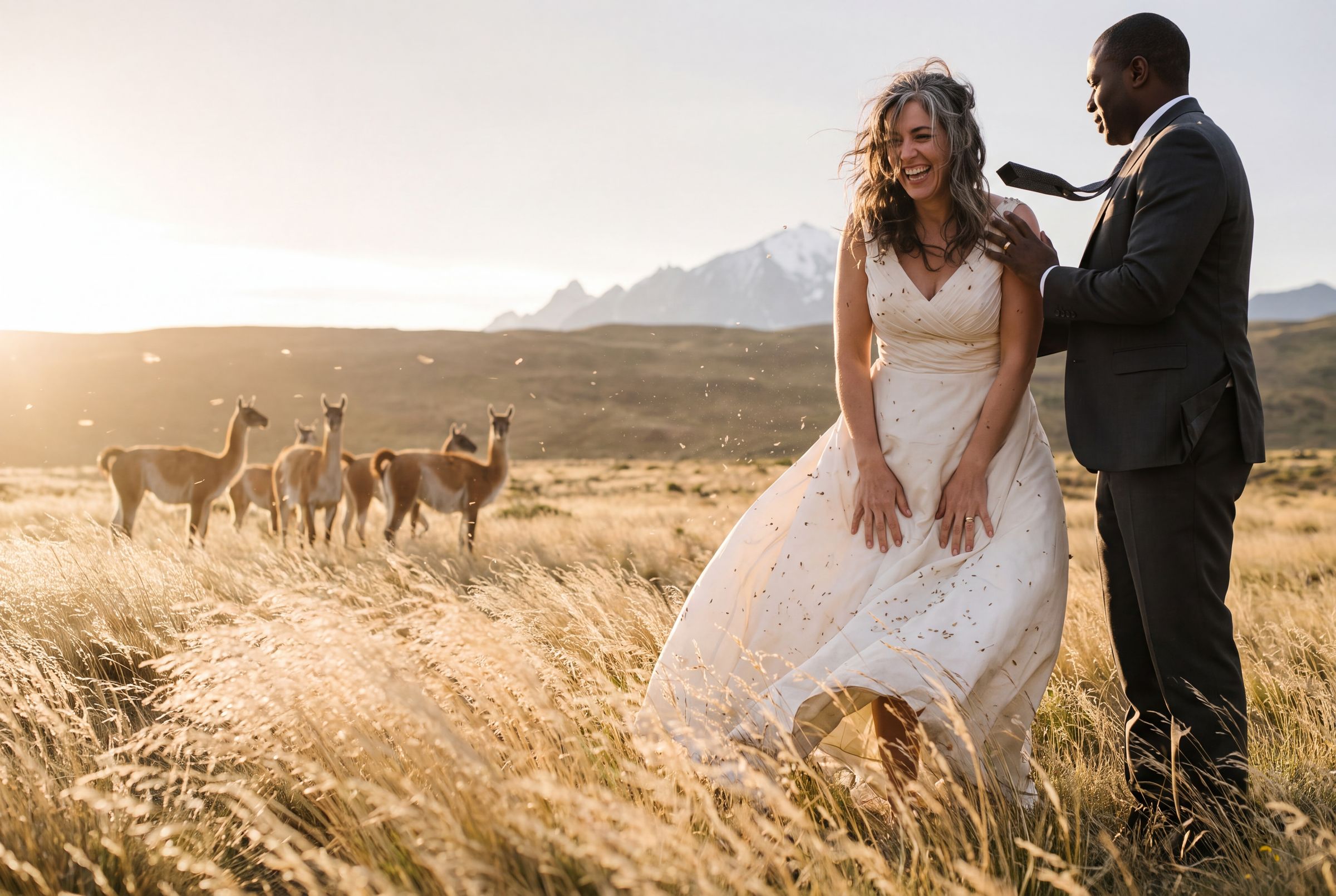
November is the season opening and it behaves like one. The park comes back to life, the guanacos have young, the grass is green rather than bleached, and you will have viewpoints to yourselves that in January hold forty people.
The gamble is that spring in Patagonia is not settled. Snow can still close higher ground, some sectors open late depending on the year, and the weather swings harder and faster than it does in February.
I build November days happily, with more alternates held in reserve than I would carry in high summer. For a couple who wants an empty park and can accept a wider range of outcomes, it is genuinely underrated.
June to August: stark, empty, and I will be blunt about it
Winter in Torres del Paine is beautiful and I will build it for the right couple, provided they understand exactly what they are buying. Snow on the granite, an empty park, and a stillness the summer never has.
What it costs is substantial and I would rather list it than soften it. Daylight collapses to about eight hours, which compresses the whole day and removes any margin for a delay. Most sectors and refugios close, so the accessible part of the park narrows to a handful of routes. Access itself gets harder, the roads are less forgiving, and a weather system that would be an inconvenience in January can end a plan in July.
The couples this suits are specific: two people, no guests, genuinely comfortable in cold, and more interested in an empty landscape than in a full itinerary. If that is not a description of you, come in March. Winter here is not a discount version of summer, it is a different undertaking.
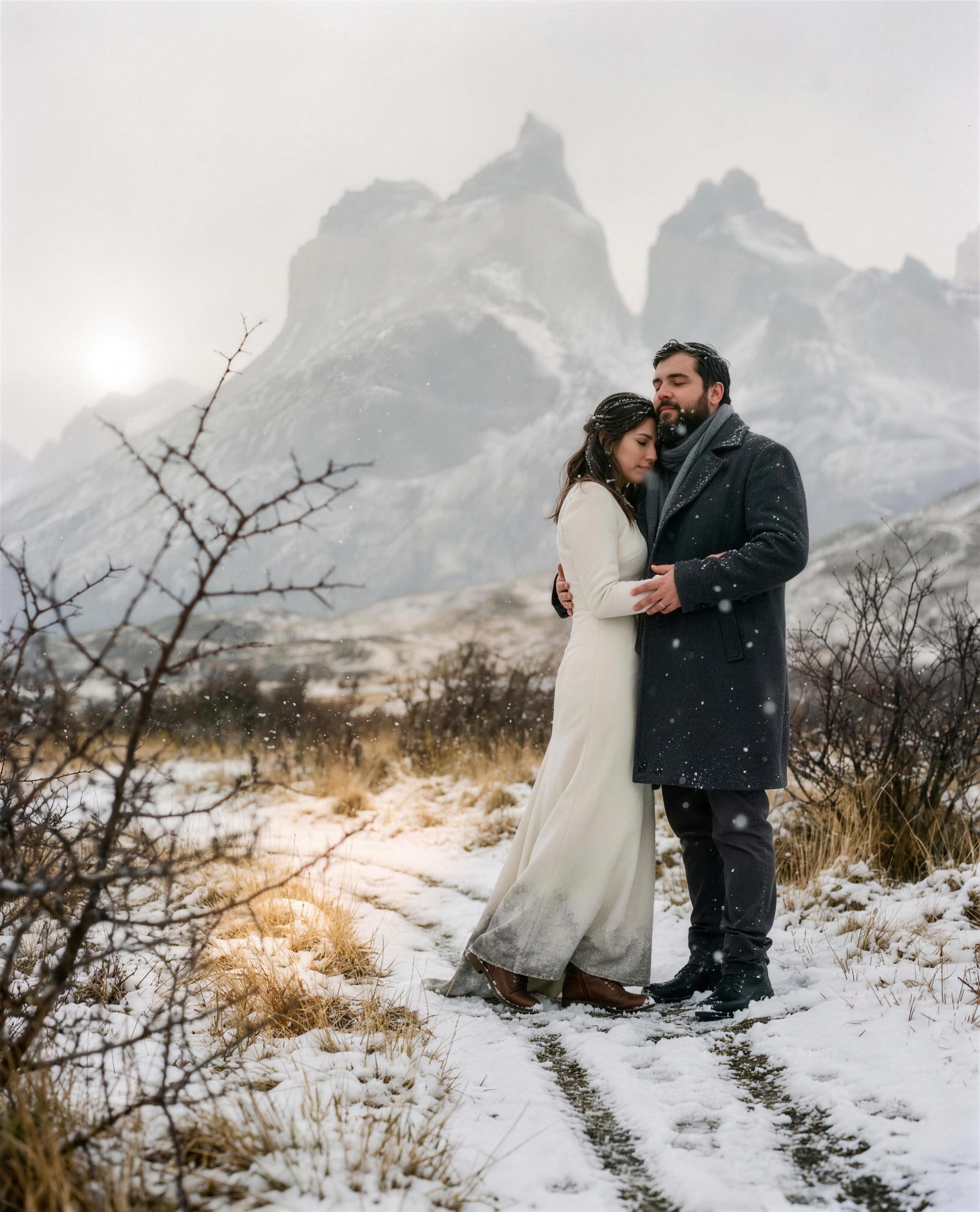
Four seasons before lunch, and what that does to a plan
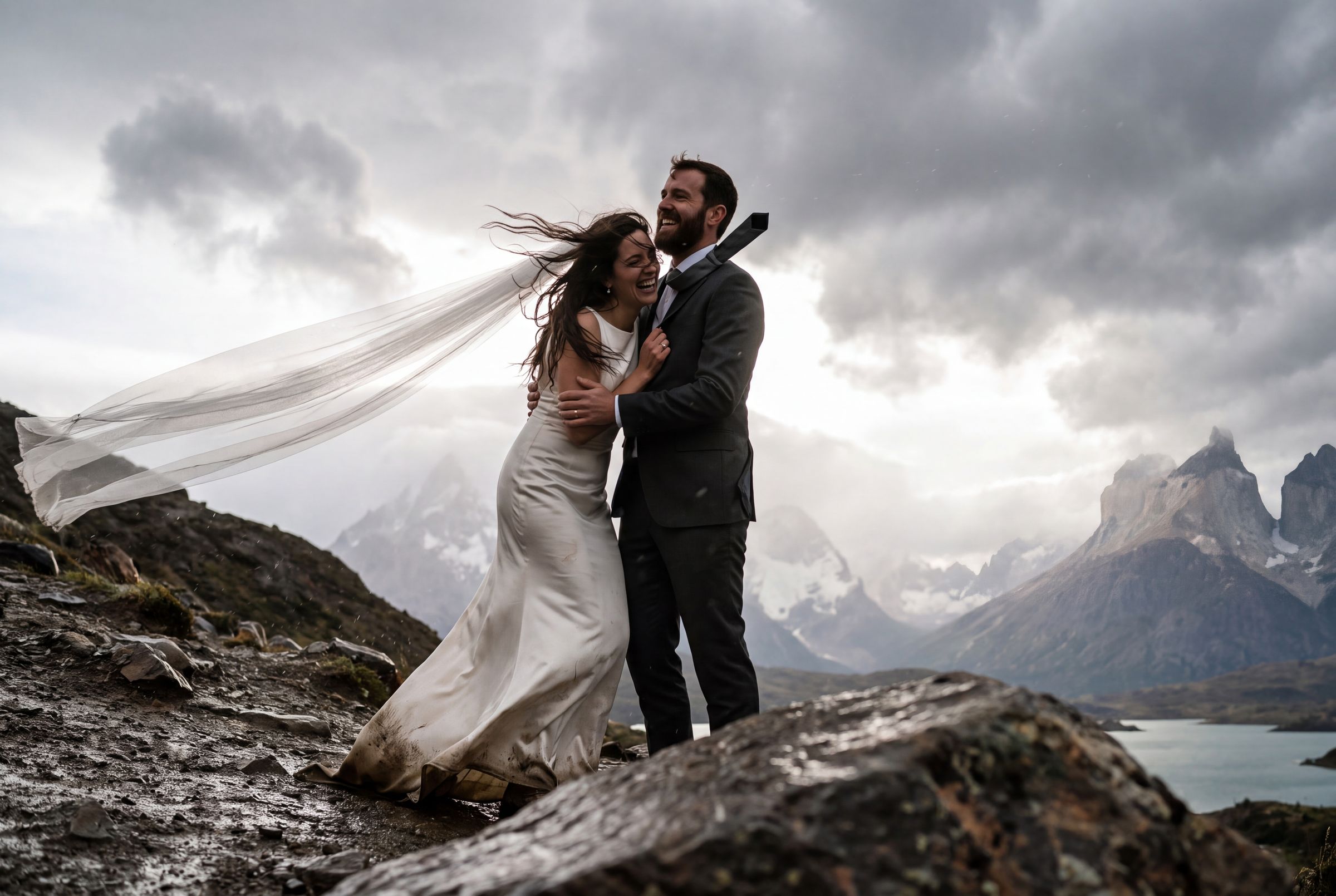
The saying about four seasons before lunch is not a local exaggeration, it is a planning constraint. Sun, wind, sleet and clear blue inside a single afternoon is ordinary here, and it is the reason I never build a Torres del Paine day around one fixed ceremony hour.
Every itinerary carries multiple windows across separate days. Each window is paired with a sheltered alternative chosen in advance and looked at in person: the waterfall at Salto Grande, the forest around Lago Grey, the shoreline at Pehoé where the light does extraordinary things under a broken sky.
Couples find this unsettling until the day arrives and then it is the thing they are most grateful for. Moving weather is why this park photographs the way it does. Some of the strongest frames in my Patagonian archive came out of a morning that looked, at eight o'clock, like a total loss.
What the wind actually changes
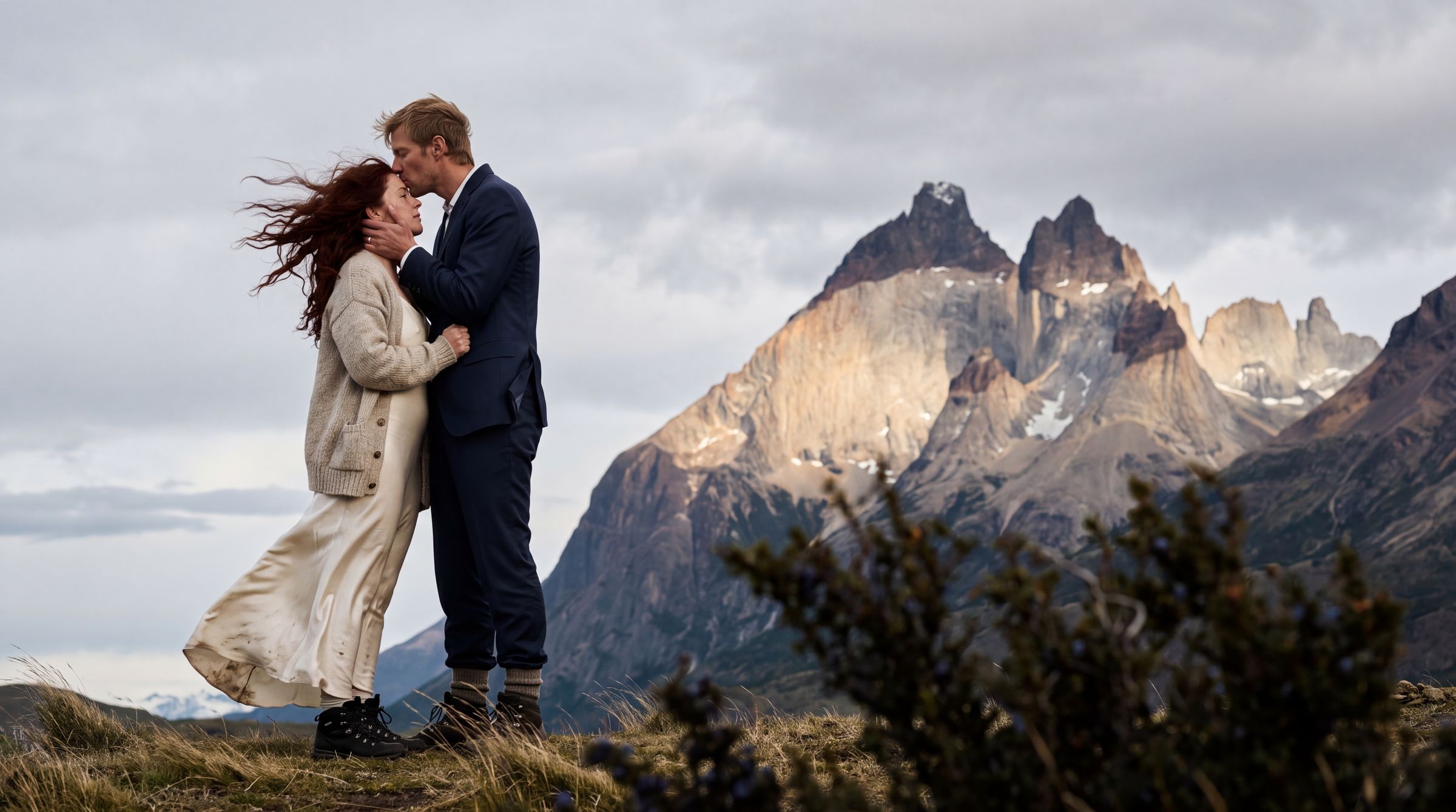
Wind decides more about a Torres del Paine wedding than temperature ever does. It governs where you can stand, what fabric survives, whether a veil is a gift or a hazard, and whether anyone can hear the ceremony at all.
The practical shape of it: the wind builds through the middle of the day and eases at the ends. A ceremony that needs stillness belongs early or late. Exposed ridgelines and open shorelines are afternoon problems. Forest and the lee of the moraines are always calmer than the map suggests.
What I ask couples to bring is fabric that is meant to move, hair that is not built for indoors, and a willingness to be photographed slightly wrecked. The alternative is trying to hold a shape against a hundred kilometre an hour gust, which nobody wins.
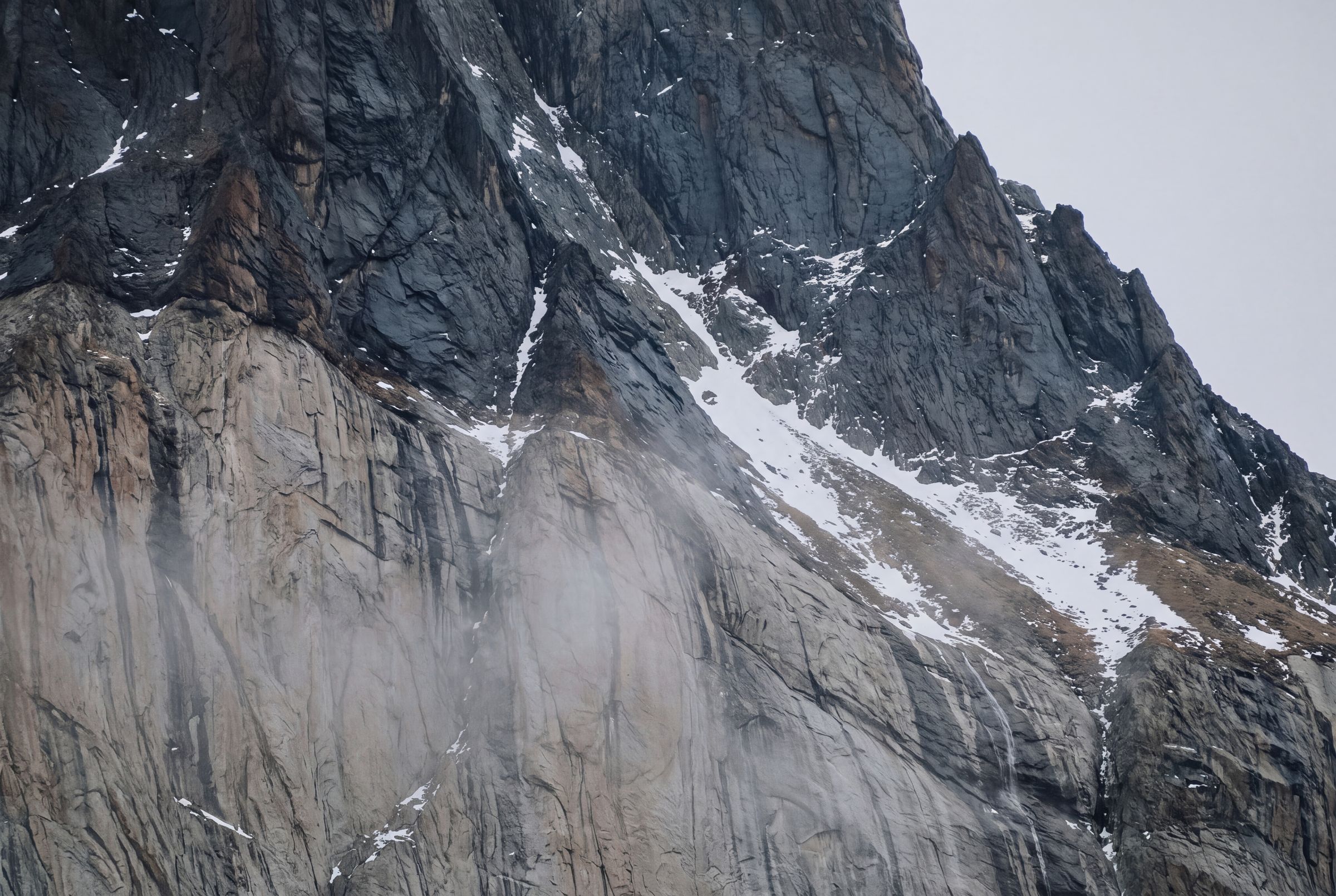
The towers, and the ten minutes that make them
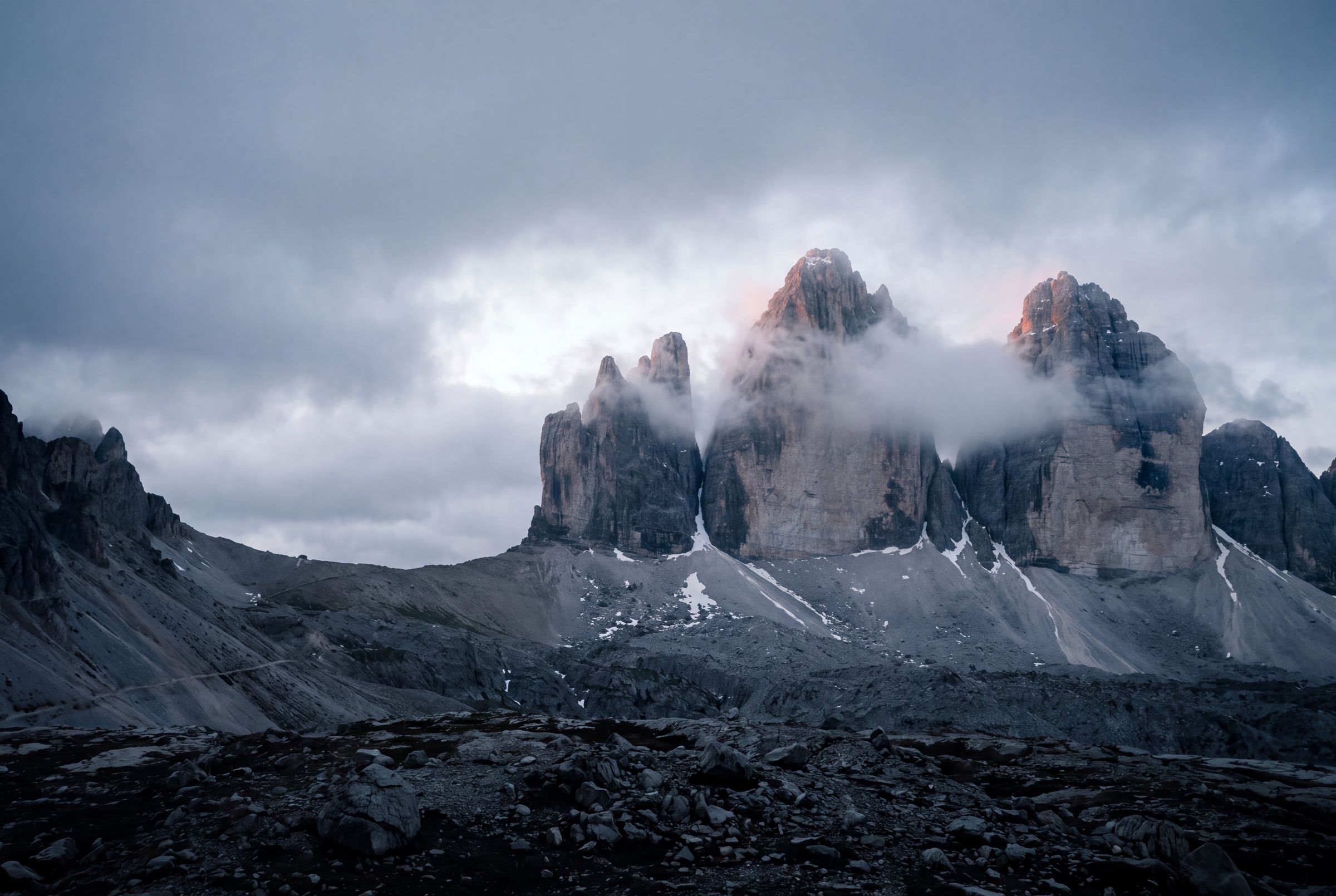
The base of the towers gives roughly ten minutes of alpenglow at first light, and it is the single most sought after view in Chilean Patagonia. It is also a serious drive plus a full day hike from the Pehoé side of the park, which is where most accommodation sits.
So this is a decision rather than an inclusion. Building the ceremony at the base of the towers means an alpine start, a long walk, and accepting that the reward may be cloud. Building it at Pehoé, Salto Grande or on the shoreline means a far gentler day with a view of the massif rather than a view from beneath it.
I have done both many times and I am not precious about either. What I will not do is let a couple sleepwalk into the hard version without knowing it is the hard version.
Beds decide your date more than I do
The refugios and park hotels sell out roughly a year in advance, and inside the park they are a closed ecosystem with their own reservation system. This is the constraint couples discover last and should discover first.
Practically it means that eight to twelve months of lead time is not me being precious, it is what the park requires of anybody. It also means that if you have a fixed date inside the peak weeks and no rooms yet, the honest answer may be a different week rather than a different plan.
As everywhere, I name the exact place and the arrival day and you book it directly. Booking accommodation on your behalf needs an agency licence I do not hold, and I would rather write that plainly than have it surface later.
Getting there, whichever way you come
Two flights, a transfer and a drive. Santiago, then Punta Arenas, then three hours north to Puerto Natales, then another ninety minutes to two hours to the park entrance. From most of North America that is a full day and a half door to door.
Many couples come the other way instead, through El Calafate in Argentina and over the Cerro Castillo border crossing, which pairs naturally with an El Chaltén leg. If you are considering both, that route is usually the better trip.
Inside the park, distances are real and they surprise people. Lago Pehoé to the base of the towers is a genuine drive plus a full day on foot. That is why my shortest tier here runs three days, with a buffer built in for weather and for flights.
What it costs
Three tiers in USD. Essential from $10,400 for one designed elopement day. Curated Signature at $21,800 adds a second elopement day, a cinematic film and the bundled experiences. Curated Adventuremoon at $28,800 weaves the elopement and honeymoon into one four day journey across the park and the fjord country around it. Photography and film in every tier, an album with each.
Underneath those numbers, itemised: the CONAF authorization and entry reservations, the bilingual officiant, the guide, the catamaran across Lago Pehoé, the styling and florals into a park a long way from any supplier, the transfers from Puerto Natales, the private estancia access where a sector needs it, and an itinerary rebuilt daily around what the sky is doing.
Airfare and accommodation you book yourself. The full ladder is on the pricing page, and the paperwork is covered in depth in the CONAF permits guide.
Who should not come here
Four kinds of couple, and where each of them should go instead.
If you need the view guaranteed, nobody can sell you that here and you should not believe anyone who tries. El Calafate puts a glacier in front of you that is there every single day.
If your trip is under five days, the travel eats it. Bariloche is one flight from Buenos Aires into an Andean lake district with roads.
If anyone with you has limited mobility, the park is unforgiving in a way I cannot design around entirely. The shoreline works; the towers do not.
If you want a legally binding ceremony on the day, Chile will not give visiting foreigners one. Banff or Vancouver will.
The month I would choose
Late March, and it is not close. The air is calmer, the forests are turning, the summer crowds have gone home, the sectors are still open, and the light is long enough to work with at both ends of the day.
December and January will give you more daylight and more certainty of access, and if your date is fixed inside them I will build you something excellent. But given a free choice and a couple who trusts me with it, I am putting you in the shoulder every time.
The Torres del Paine page lays out the sectors, the experiences and the day itself. When you have a window in mind, start the conversation and I will tell you which weeks of it I am in the country.