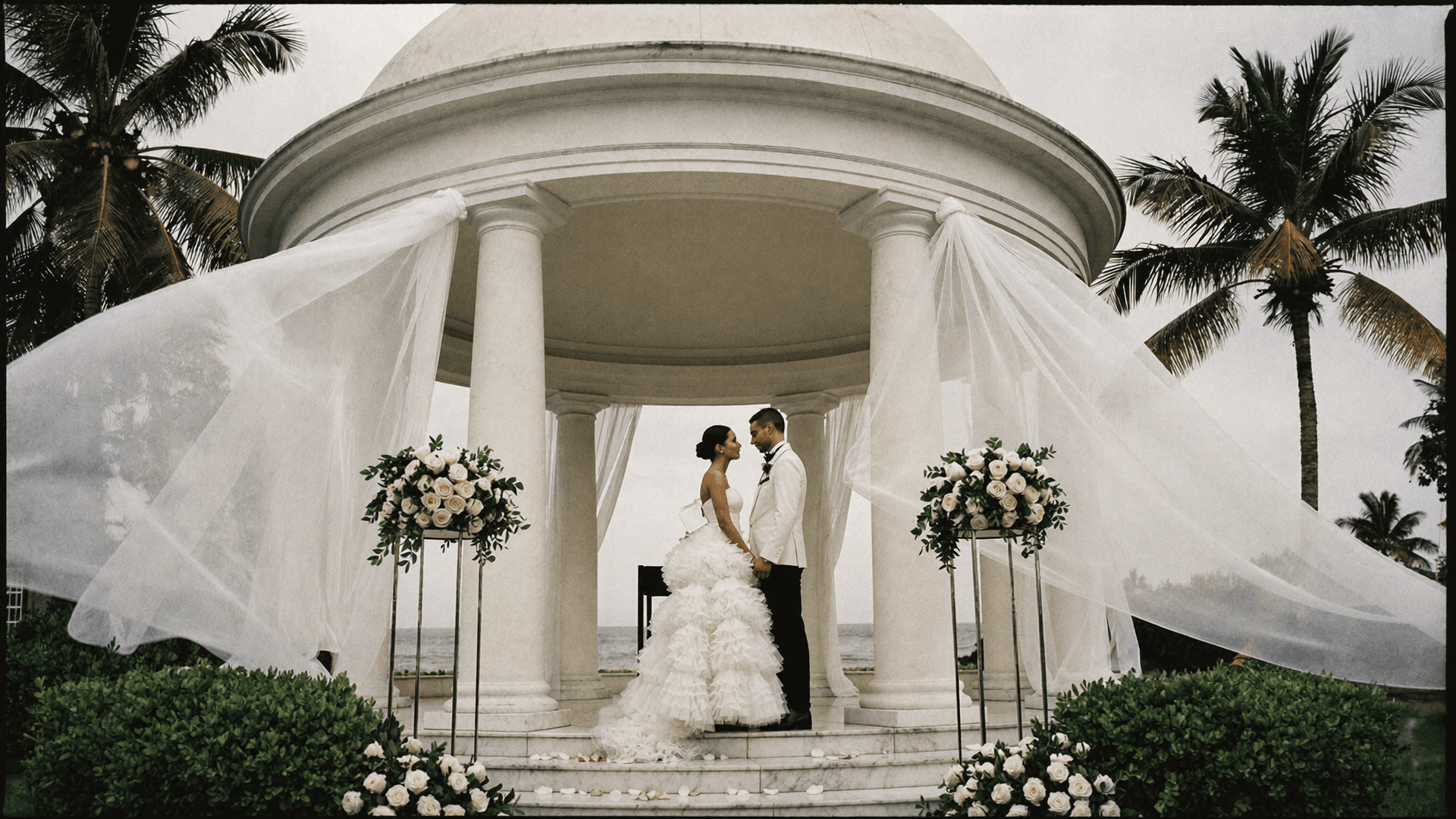
There is an elopement I photographed in Banff in September 2019 that I still think about. 180 guests, three days of events, Fairmont Banff Springs from Friday through Sunday. Beautiful by every objective measure. The photographs are good. But watching it, I remember thinking: whose elopement is this, exactly?
That question has fewer complicated answers in 2022. The couples I am booking now have had two years to sit with the question of what they actually want from an elopement, and the answers are clearer, smaller, and more honest. The pandemic did not kill the Canadian destination elopement. It clarified it.
Banff: From Production to Presence
Banff was already the country's premier destination elopement market before 2020, the Fairmont Banff Springs, Emerald Lake Lodge, and the Rimrock Resort were all booking 18 to 24 months out. What the pandemic did was clear those books and force a reset. When Banff reopened to domestic travel in mid-2021, the couples who were booking were different: smaller guest lists (I am averaging 35-50 people at Banff elopements in 2022, down from 80-100 pre-pandemic), more flexibility on venue, and a genuine interest in spending time in the national park rather than treating Banff as a backdrop for a large-scale event.
The photographs are, without exception, better. When a couple is present in their day rather than managing a production, the images reflect that. The unguarded moments are more available. The emotion is closer to the surface. I am making better portraits in Banff in 2022 than I was making in 2019, and the guest count has almost nothing to do with it.
Tofino: The Pandemic's Surprise Discovery
Tofino was not on most destination elopement radars in 2019. It was a surf town, beautiful, remote, beloved by a specific demographic of Pacific Northwesterners who could handle the drive from Victoria or the float plane from Vancouver. The pandemic changed that completely. When international travel closed and domestic travel opened, couples who had been planning Italy or Mexico or Greece suddenly turned their attention to what Canada had at home, and Tofino was one of the places they found.
I photographed my first Tofino elopement in October 2020, during the narrow window when outdoor gatherings of limited size were permitted in BC. The beach ceremony, fifteen people, Pacific fog rolling in from the ocean, it was the most genuinely intimate elopement I had photographed to that point. The images are extraordinary. Since then I have had three more Tofino inquiries for 2022 and 2023, all from couples who explicitly said the pandemic showed them they did not need 100 people to have a meaningful day.
Whistler: Domestic Demand, International Quality
Whistler saw a surge in domestic Canadian destination bookings through 2021 and into 2022 that I do not think will reverse when international travel fully normalises. Couples who discovered Whistler as an alternative to an Austrian or Swiss alpine elopement are not going to abandon it now that they have found it. The Scandinave Spa, Nita Lake Lodge, and the Four Seasons have all told me they are at capacity through 2023 for weekends. That was not the situation in 2019.
The visual vocabulary of Whistler elopements has also shifted. Pre-pandemic, the dominant aesthetic was resort luxury, hotel ballroom, formal florals, traditional setup. What I am seeing in 2022 is more outdoor, more trail-adjacent, more interested in the mountain landscape as an active environment rather than a backdrop. Couples are hiking to portrait locations rather than asking me to find something convenient to the lobby. That is a different kind of couple, and they produce a different kind of image.
Vancouver: The City Elopement That Got Smaller
Vancouver domestic elopements took a specific hit during the pandemic: the venues that rely on large indoor gatherings, the Convention Centre, the larger hotel ballrooms, struggled, while the intimate venue category boomed. The Botanist, the Vancouver Club's private dining rooms, smaller Gastown event spaces, all of these were easier to adapt to outdoor or limited-capacity events and emerged from 2020-2021 with stronger demand than they entered it with.
What I find most significant is the shift in who is booking Vancouver as a destination, that is, couples from other Canadian cities or internationally, who are coming specifically for Vancouver rather than just planning a local elopement. That category has grown noticeably. The city's profile as a destination, boosted by years of international film production and ongoing media coverage, is now generating genuine elopement tourism at a scale that was not present pre-pandemic.
Montréal and Toronto: The Underrated Urban Options
Both cities had their destination elopement markets disrupted severely by the pandemic and are now recovering in interesting ways. Montréal's Old Port and Plateau neighbourhoods are seeing renewed interest from European-heritage couples who would previously have gone to France or Portugal and are now reconsidering. The comparison is fair: the architecture of Vieux-Montréal genuinely rivals the old towns of many European cities, and the logistical simplicity of staying in Canada is significant for families with elderly relatives or complicated travel situations.
Toronto I am watching carefully. The Distillery District specifically, already one of the most photogenic event spaces in the country, is booking at a pace that suggests a more sustained cultural shift toward Toronto as a serious destination rather than a default choice for locals. Non-Toronto Canadian couples and Americans are choosing it deliberately.
What Has Not Changed
The light. The mountains. The particular quality of what Canada looks like in September and October when the larch trees turn and the sky goes that specific northern blue. None of that changed. What changed is that couples are arriving with clearer eyes to see it, and smaller groups that let them actually be present in it.
I am shooting better work in Canada in 2022 than I was in 2019. I say that with genuine surprise, because 2019 was not a bad year. But the pandemic stripped away a layer of performance from these days, and what is underneath is more honest and more interesting to photograph.
I will take it.
Making the Most of the your destination Context
Every destination has a specific context that is worth using deliberately rather than treating as background. At your destination, that context is the combination of light quality, natural or architectural setting, and the particular atmosphere of the place at different times of day. The sessions that use this context most effectively are the ones where the couple has spent time at your destination before the ceremony day: walking the neighbourhood, sitting at a viewpoint, becoming familiar with the place at different hours so that on the ceremony morning it is somewhere they know rather than somewhere they are experiencing for the first time under the pressure of the session schedule.
I recommend arriving at your destination at least one full day before the ceremony date for this reason. The first day is for orientation: finding the route to the ceremony site, having a meal at a restaurant they want to return to that evening, walking through the area without a camera or a schedule. The second day is the ceremony day, and the familiarity accumulated on the first day shows in how the couple moves through the space and how present they are during the session rather than navigating it as strangers. The photographs from a couple who knows the place, even slightly, are different from the photographs of a couple experiencing it for the first time.
Making the Most of the your destination Context
Every destination has a specific context that is worth using deliberately rather than treating as background. At your destination, that context is the combination of light quality, natural or architectural setting, and the particular atmosphere of the place at different times of day. The sessions that use this context most effectively are the ones where the couple has spent time at your destination before the ceremony day: walking the neighbourhood, sitting at a viewpoint, becoming familiar with the place at different hours so that on the ceremony morning it is somewhere they know rather than somewhere they are experiencing for the first time under the pressure of the session schedule.
I recommend arriving at your destination at least one full day before the ceremony date for this reason. The first day is for orientation: finding the route to the ceremony site, having a meal at a restaurant they want to return to that evening, walking through the area without a camera or a schedule. The second day is the ceremony day, and the familiarity accumulated on the first day shows in how the couple moves through the space and how present they are during the session rather than navigating it as strangers. The photographs from a couple who knows the place, even slightly, are different from the photographs of a couple experiencing it for the first time.
Making the Most of the your destination Context
Every destination has a specific context that is worth using deliberately rather than treating as background. At your destination, that context is the combination of light quality, natural or architectural setting, and the particular atmosphere of the place at different times of day. The sessions that use this context most effectively are the ones where the couple has spent time at your destination before the ceremony day: walking the neighbourhood, sitting at a viewpoint, becoming familiar with the place at different hours so that on the ceremony morning it is somewhere they know rather than somewhere they are experiencing for the first time under the pressure of the session schedule.
I recommend arriving at your destination at least one full day before the ceremony date for this reason. The first day is for orientation: finding the route to the ceremony site, having a meal at a restaurant they want to return to that evening, walking through the area without a camera or a schedule. The second day is the ceremony day, and the familiarity accumulated on the first day shows in how the couple moves through the space and how present they are during the session rather than navigating it as strangers. The photographs from a couple who knows the place, even slightly, are different from the photographs of a couple experiencing it for the first time.
Destination Wedding Photographer
Vancouver · Medellín · Worldwide